Cooling of a half-space
A half-space whose surface is suddenly held cold cools by conduction along the error-function profile
the classic model for the cooling of oceanic lithosphere with age. This benchmark starts DES from the profile of a 1-million-year-old plate and lets it cool to 100 million years.
| Dimension | 2D and 3D, same input |
| Build | make ndims=2 and make ndims=3 |
| Run time | 6 s (2D) and 41 s (3D) on 8 threads |
| Inputs | benchmarks/heat/half-space-cooling/diffusion.cfg in the DynEarthSol repository |
| Checked with | DynEarthSol 68cc2a0 |
Setup
| Setting | Value |
|---|---|
| Domain | 10 km wide (and 10 km long in 3D), 250 km deep; element size about 2 km |
| Temperature | = 273 K held at the top; insulated sides and base; initial profile of a plate 1 Myr old with = 1600 K (ic.temperature_option = 0) |
| Thermal properties | = 3 W/m/K, = 1000 J/kg/K, = 3000 kg/m³, so m²/s |
| Mechanics | elastic, no gravity, a very small characteristic speed so that the thermal time step controls |
| Output | a frame every 1 Myr to 100 Myr |
At 100 Myr the cooling front, , is 112 km deep, well above the insulated base at 250 km, so the half-space solution applies.
Input and how to run
cd benchmarks/heat/half-space-cooling
../../../dynearthsol2d diffusion.cfg
../../../dynearthsol3d diffusion.cfg
Each run writes diffusion.save.*. Frame is the plate at age Myr.
benchmarks/heat/half-space-cooling/diffusion-plot.py plots frames 0, 9 and 59 against the
error function; it was written for Python 2 and the earlier output reader.
What to look for
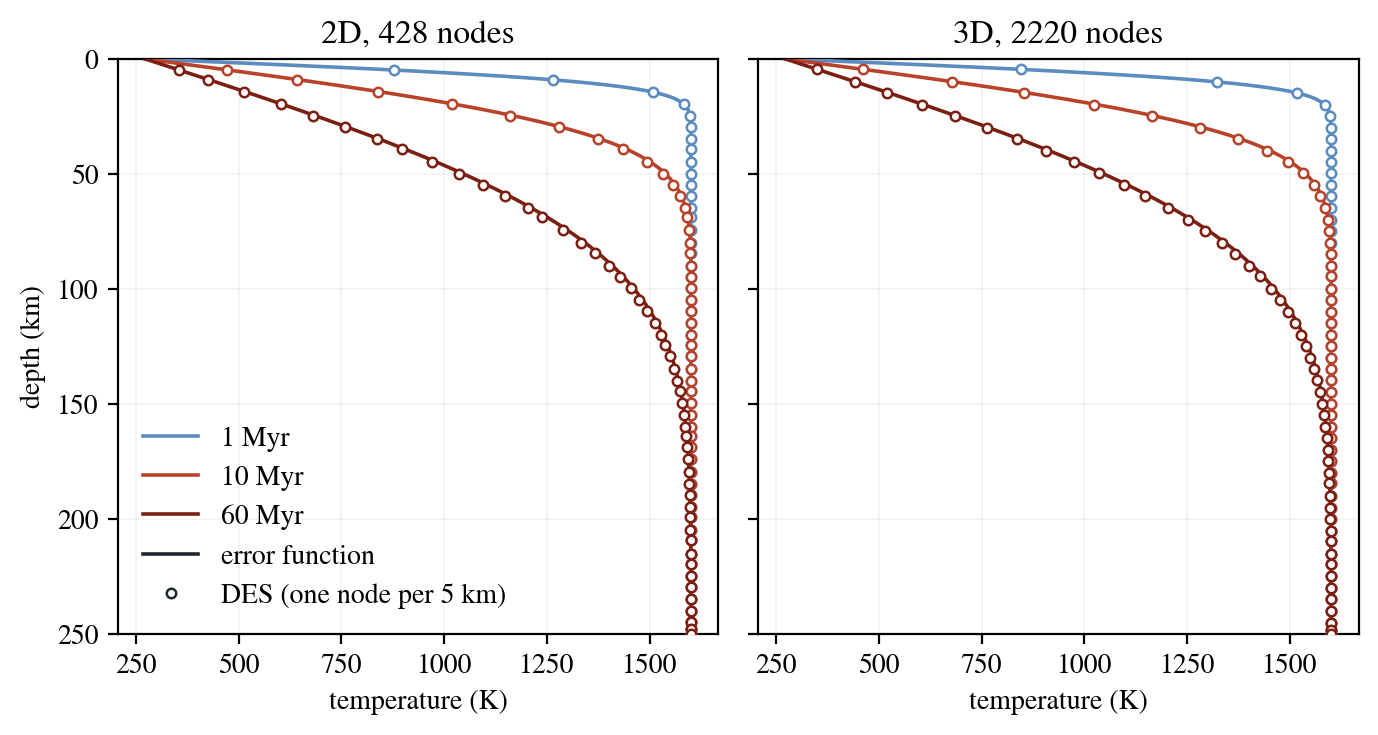
| Plate age | Largest difference, 2D | Largest difference, 3D | With mat.alpha = [0], 2D | With mat.alpha = [0], 3D |
|---|---|---|---|---|
| 1 Myr (initial) | 2.6 K | 2.6 K | 0.0 K | 0.0 K |
| 10 Myr | 8.3 K | 9.1 K | 1.2 K | 1.1 K |
| 60 Myr | 9.6 K | 9.7 K | 0.21 K | 0.26 K |
DES follows the error function in both dimensions, within 10 K of a
1327 K range. Most of that difference is not numerical. The input does not
set mat.alpha, so the default thermal expansion, K⁻¹,
makes the density, and so the diffusivity, depend on temperature, while the
error function assumes a constant diffusivity. The same input with
alpha = [ 0 ] in [mat] comes within 1.2 K at 10 Myr and 0.3 K at
60 Myr. Even the initial profile differs by up to 2.6 K, because DES
evaluates it with the density of the first element.
Limits
- Conduction only. There is no advection, heat source or shear heating.
- One resolution. The element size is fixed at about 2 km; the near- surface gradient at 1 Myr is resolved by about five elements.