Fluid injection into a poroelastic borehole
Fluid at pressure enters a borehole wall: it loads the wall and diffuses into the rock, which changes the stresses around the hole as it goes. The axisymmetric part of Detournay and Cheng’s borehole problem, on a finite annulus.
On the 0.05 a mesh: pressure within 0.06% of at every node for 1.05 a ≤ r ≤ 4 a and all four times; total stress rms 0.16% (hoop) with a largest element error of 1.06%.
| Dimension | 2D |
| Build | make ndims=2 from the poromechanics source (not yet merged; DynEarthSol #134) |
| Inputs | borehole.zip |
| Reproduce with | DynEarthSol 3774df0 |
Problem setup
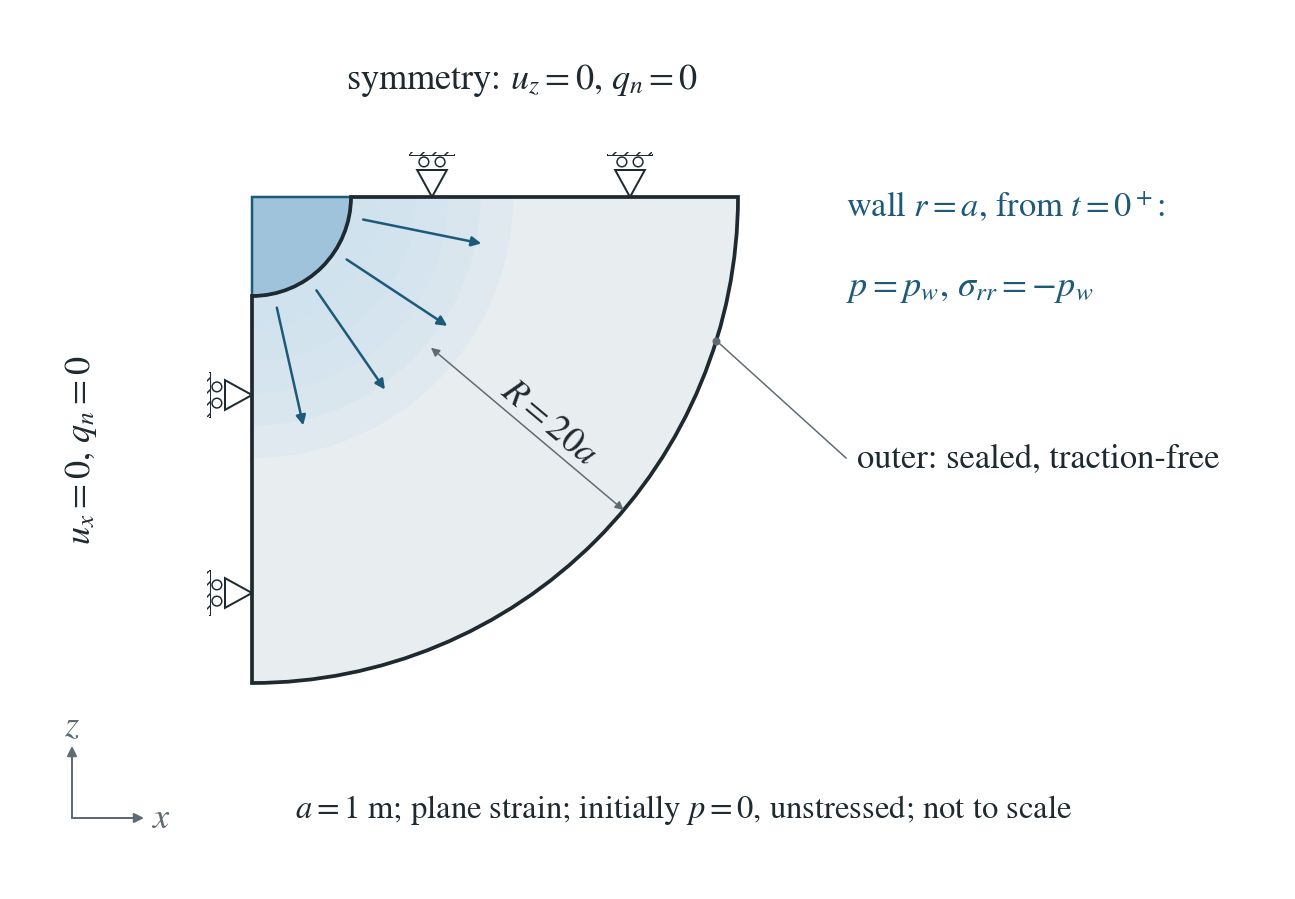
Geometry. A quarter annulus m, , plane strain, with symmetry rollers on both cuts; meshes refined out to .
Loading. At the wall takes fluid at MPa: pore pressure (a 1 ms ramp) and normal traction . The outer arc is sealed and traction-free. The rock starts unstressed at ; gravity is off.
Material. MPa, MPa, , , ; diffusivity .
What is compared. Nodal pressure and element total radial and hoop stress for at 9, 18, 27 and 36 s, relative to .
Input and how to run
Every file this example needs is in borehole.zip. Run from that folder:
# Meshes the quarter annulus from annulus.poly (shipped alongside) at 0.05 m inner spacing and runs 144 steps of 0.25 s (36 s), saving hole.save.* every 36 steps (9, 18, 27 and 36 s) with hole.info listing the frames.
dynearthsol2d input.cfg
Settings that define this example
| Setting | Value | What it does here |
|---|---|---|
mesh.meshing_option | 90 | 90: mesh the polygon read from poly_filename |
mesh.poly_filename | annulus.poly | annulus.poly: quarter annulus a = 1 m to R = 20 m with a refined ring to 5a; flags: vertical cut x0, borehole wall x1, horizontal cut z0, outer arc z1 |
mesh.resolution | 0.05 | 0.05 m element size near the wall, the finest mesh of the study |
bc.hbc_x1 | 2 | type 2: pore pressure prescribed on the borehole wall from hbc_pressure |
bc.hbc_pressure | [0,1000000.0,0,0,0,0] | the x1 (wall) entry is the fluid pressure p_w = 1 MPa |
bc.stress_bc_x1 | 4 | type 4: normal stress on the curved wall |
bc.stress_val_x1 | -1000000.0 | −p_w: the wall fluid pushes on the rock (tension positive) |
bc.num_hbc_schedule | 2 | two schedule points for the wall pressure |
bc.hbc_schedule_time_in_yr | [0, 3.168876453507857e-11] yr = [0, 0.001] s | 0 and 1 ms: the wall pressure ramps on almost instantly |
bc.hbc_schedule_ratio | [0, 1] | 0 to 1, then held at p_w |
mat.hydraulic_perm | [1e-12] | k = 1e-12 m²; with water viscosity 1e-3 Pa s the mobility k/μ is 1e-9 m²/(Pa s) |
mat.fluid_bulk_modulus | [200000000.0] | K_f = 200 MPa; with porosity 0.2 the storage 1/M = φ/K_f is 1e-9 /Pa |
mat.bulk_modulus | [200000000.0] | K = 200 MPa (shear modulus 100 MPa); together they give diffusivity c = 0.25 m²/s |
sim.output_step_interval | 36 | 36 steps: frames at 9, 18, 27 and 36 s, the four compared times |
input.cfg holds all 57 settings that differ from DES’s defaults; dynearthsol2d -h lists every option with its default.
Output
See Running the examples for output files, the Python reader and ParaView conversion.
| Field | What to look at |
|---|---|
pore pressure | nodal pressure, binned by radius and compared with the reference in panel (a) |
stress | element total stress, rotated to radial and hoop components in panel (b) |
Result: DES and the analytical solution
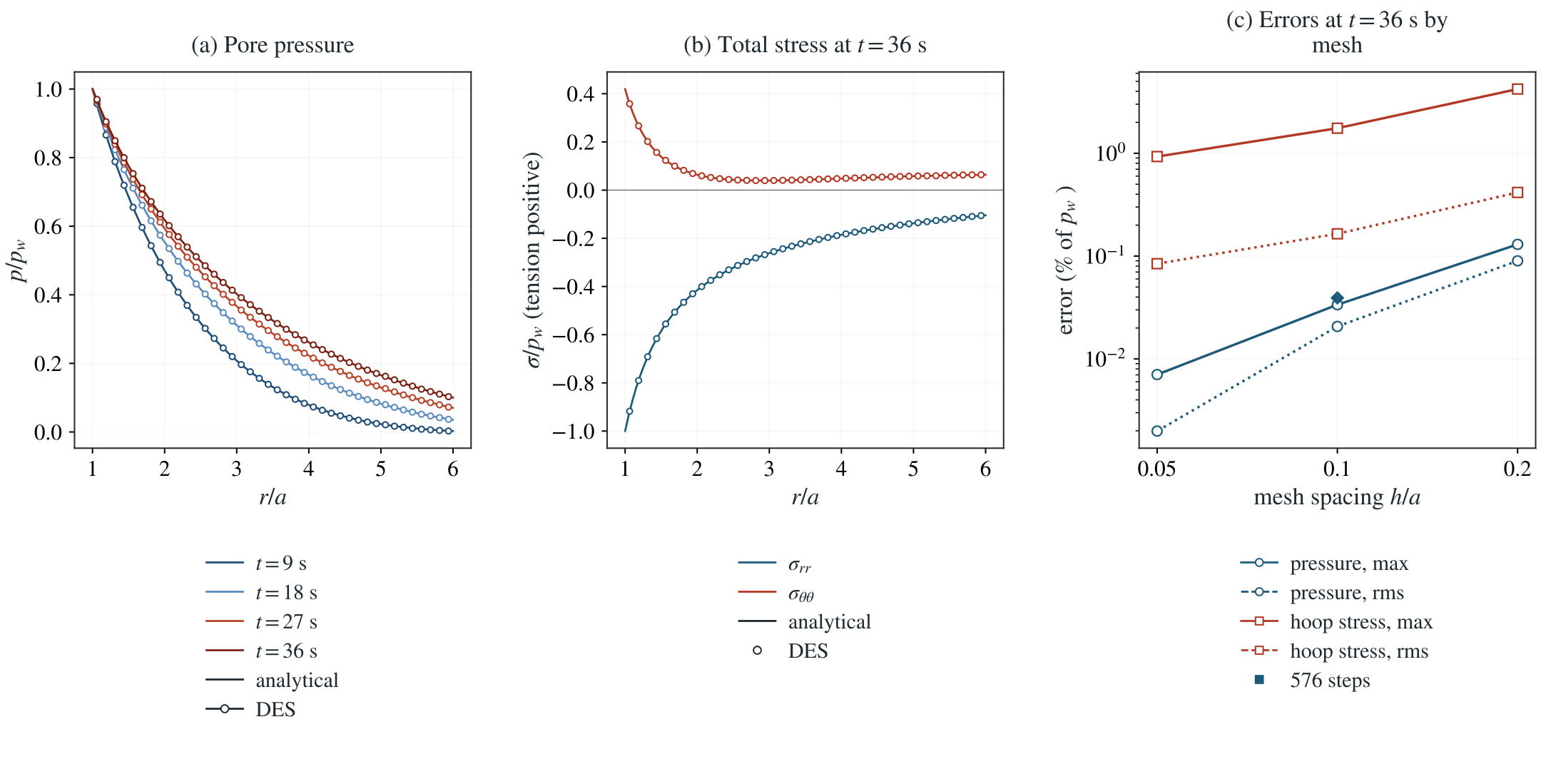
(a) Pore pressure, scaled by the wall pressure p_w, against distance from the borehole centre at the four saved times: lines, the finite-annulus poroelastic solution; symbols, DES. (b) Total radial and hoop stress, scaled by p_w, at the last saved time. (c) Largest pressure and stress errors against mesh spacing.
This checks the coupled poroelastic response around an opening: diffusion from a curved boundary, the pressure-driven hoop stress and the wall load together.
To reproduce the whole study behind this figure, from the DES source folder:
python3 benchmarks/poromechanics/borehole_reference.py
python3 tests/functional/hydromechanics/check_borehole.py dynearthsol2d OUT/mesh --spacings 0.2 0.1 0.05
python3 tests/functional/hydromechanics/check_borehole.py dynearthsol2d OUT/steps --spacings 0.1 --steps 576
The study’s full numbers: record.json.
Analytical reference
Tension positive. The radial displacement is , so the volumetric strain is ; and follow from the two traction conditions and are linear in and .
Derivation
Radial symmetry makes the displacement irrotational, so equilibrium integrates once: the volumetric strain is plus a uniform term . Fluid mass, , then gives the diffusion equation above.
On a finite annulus and depends on , which couples the pressure to its own integral; it moves the pressure by about 1% of here. In Laplace space the pressure is a Bessel (, , , ) solution plus a uniform part , with from one scalar equation; Stehfest inversion agrees with an independent Crank–Nicolson solution to of .
Detournay and Cheng (1988), International Journal of Rock Mechanics and Mining Sciences 25(3), 171–182, axisymmetric loading modes; the finite annulus is solved in borehole_reference.py.
Validity and limits
Axisymmetric loading only (no deviatoric in-situ stress), linear poroelasticity, small strain. The finite annulus is part of the reference; the infinite-medium Detournay–Cheng solution is its limit.