Undrained wave in a sealed column
A small initial velocity sets a sealed saturated column oscillating; compression raises the pressure and expansion lowers it.
Largest velocity error: 0.171% and largest pressure error: 0.262% of their amplitudes, over all nodes and 65 saved times.
| Dimension | 3D |
| Build | make ndims=3 from the poromechanics source (not yet merged; DynEarthSol #134) |
| Inputs | wave.zip |
| Reproduce with | DynEarthSol 3774df0 |
Problem setup
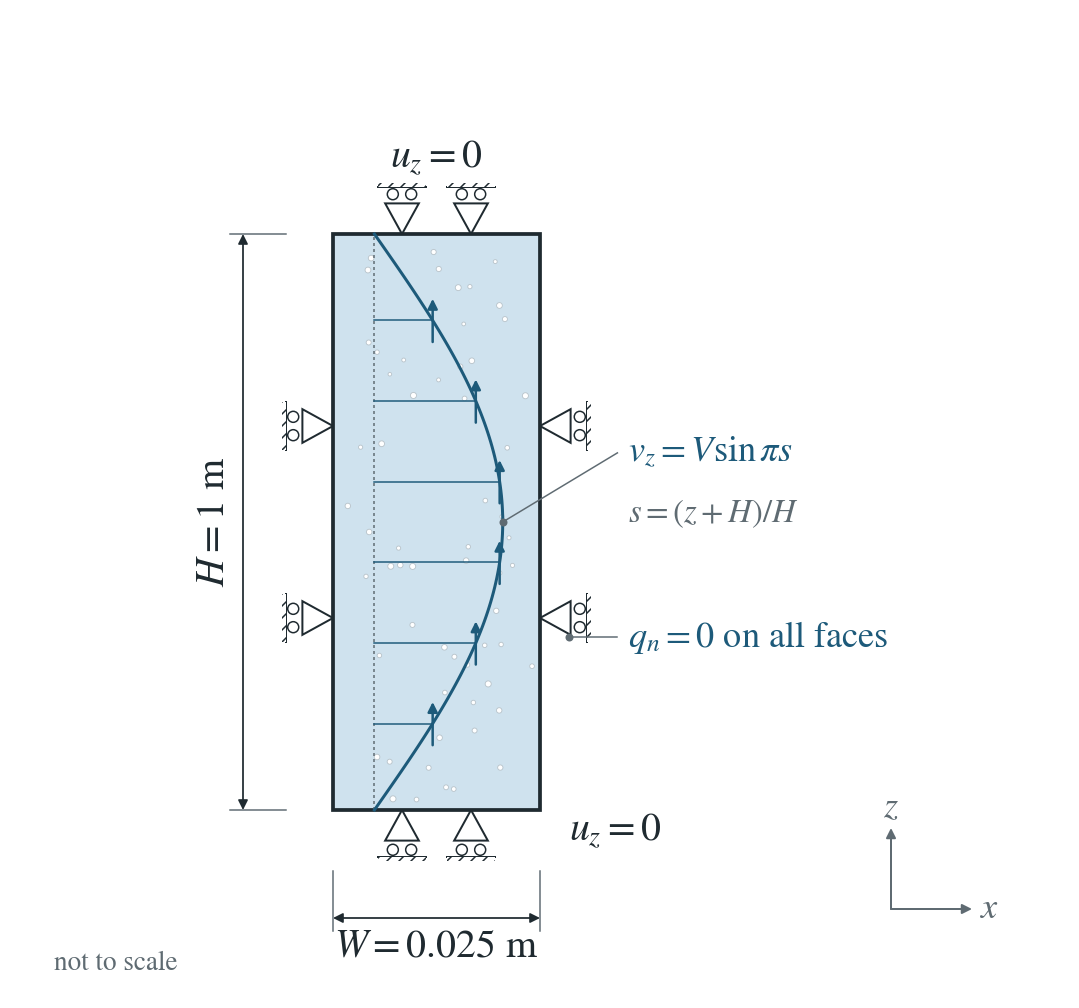
Water and displacement boundaries. All water boundaries sealed; κ = 0 throughout. End vertical displacement and side-normal displacement fixed.
Initial disturbance. , m/s. Initially zero pressure, stress and strain.
Physical regime and comparison. Physical mixture density; no gravity, damping, heating, PT or GVS. Compare velocity and pressure over one period.
Input and how to run
Every file this example needs is in wave.zip. Run from that folder:
# 3D. Restarts from the shipped checkpoint seed, frame 0: the column mesh with zero stress, strain and pressure and the initial sine velocity (listed in initial-velocity.csv). Runs 8192 explicit steps, one wave period, saving every 128th step as wave.* and writing a checkpoint at every saved frame.
dynearthsol3d input.cfg
Settings that define this example
| Setting | Value | What it does here |
|---|---|---|
sim.is_restarting | true | starts from the seed checkpoint, which holds the initial velocity; an input file cannot set an initial velocity, so undrained_wave.py writes it into the seed frame |
sim.restarting_from_modelname | seed | the checkpoint to start from: seed (shipped) |
control.is_quasi_static | false | dynamic run with physical (unscaled) mass, so inertial_scaling has no effect |
control.damping_option | 0 | no damping: the wave keeps its amplitude |
control.fixed_dt | 1.4182426918901539e-07 | one wave period divided by 8192 |
sim.max_steps | 8192 | 8192 steps: exactly one period |
sim.output_step_interval | 128 | a frame every 128 steps: 65 saved times over the period |
mat.hydraulic_perm | [0] | zero permeability: no flow, so each point stays undrained |
control.has_hydraulic_diffusion | true | solves the pore-pressure equation; with zero permeability the pressure follows the volume change only |
bc.vbc_z0 | 1 | with vbc_z1: the ends cannot move vertically; vbc_y0, vbc_y1 and the default vbc_x0, vbc_x1 fix the side-normal motion |
control.gravity | 0 | no gravity: the column is unstressed apart from the wave |
mesh.meshing_elem_shape | 1 | regular structured mesh of the 0.025 × 0.025 × 1 m column |
mat.bulk_modulus | [10000000.0] | with shear_modulus, porosity and the fluid and grain moduli, sets the undrained modulus and the wave speed |
control.has_moving_mesh | false | fixed geometry: small-strain wave |
input.cfg holds all 50 settings that differ from DES’s defaults; dynearthsol3d -h lists every option with its default.
Output
See Running the examples for output files, the Python reader and ParaView conversion.
| Field | What to look at |
|---|---|
velocity | vertical component at the node nearest mid-height, normalized by the initial amplitude V, in (a); maximum error over all nodes in the result |
pore pressure | at the base node, normalized by the pressure amplitude, in (b); maximum error over all nodes in the result |
strain | volumetric strain, combined with the pressure to check that the local fluid content stays zero |
Result: DES and the analytical solution
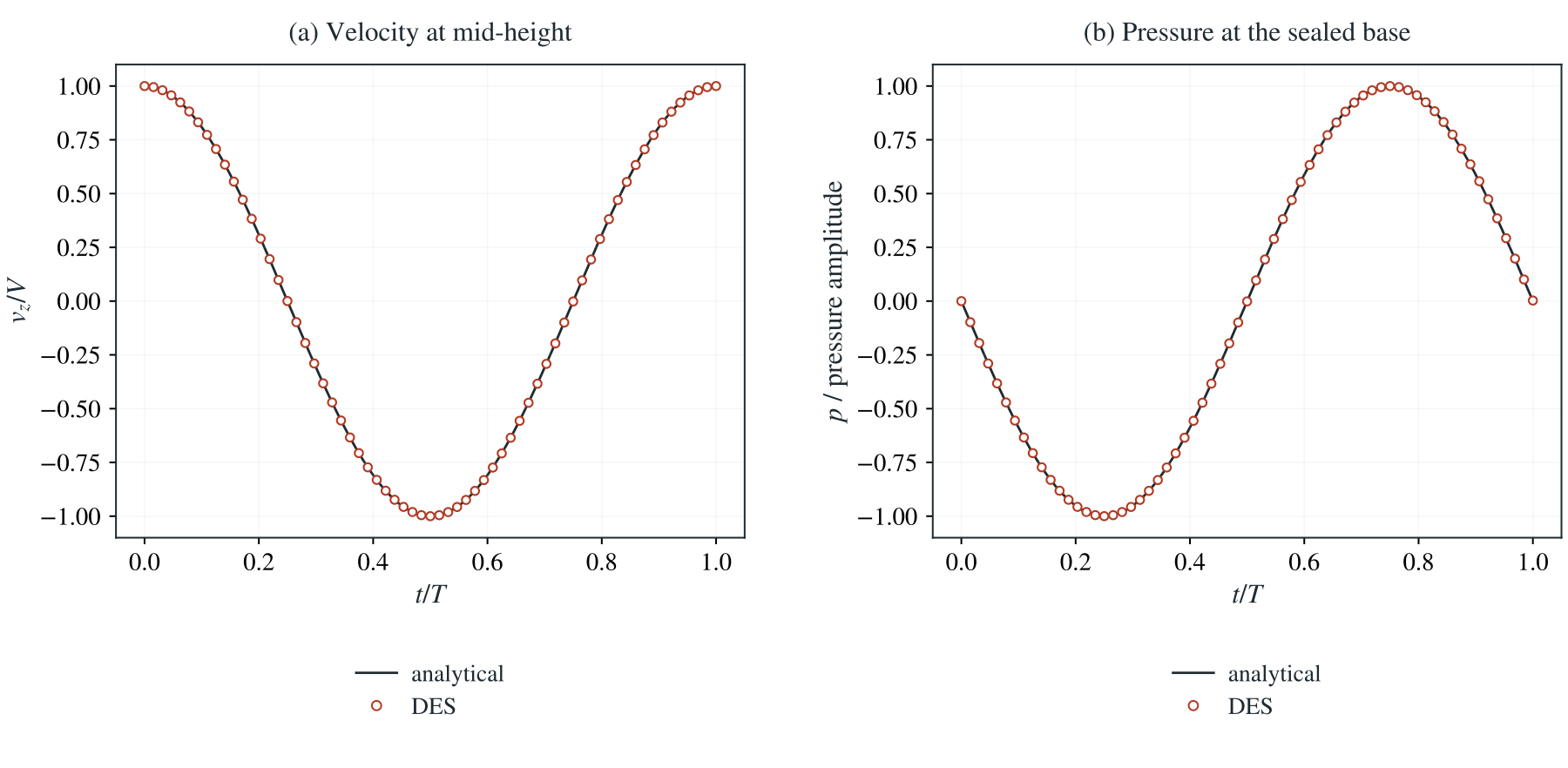
(a) Vertical velocity at mid-height over one period, normalized by the initial amplitude V: line, eigenmode solution; symbols, DES saved frames. (b) Pore pressure at the sealed base over the same period, normalized by the pressure amplitude.
This checks fluid storage and elastic wave coupling together; local fluid content is conserved to round-off. It does not test a GVS earthquake cycle.
To reproduce the whole study behind this figure, from the DES source folder:
python3 benchmarks/poromechanics/undrained_wave.py dynearthsol3d OUT --spacing .0125 --steps 1024 2048 4096 8192 --samples 64 --restart-check
python3 benchmarks/poromechanics/undrained_wave.py dynearthsol3d OUT-h005 --spacing .05 --steps 4096 --samples 32
python3 benchmarks/poromechanics/undrained_wave.py dynearthsol3d OUT-h0025 --spacing .025 --steps 4096 --samples 32
The study’s full numbers: record.json.
Analytical reference
is the DES coordinate, at the base and at the top. is the initial velocity amplitude, physical mixture density, the undrained constrained modulus and the wave period. The selected material gives .
Derivation
Sealed local fluid content remains zero because it starts at zero. Eliminate pressure from the uniaxial effective-stress relation, giving an undrained modulus in the momentum equation.
The fundamental sine mode vanishes at both fixed ends. Choose its amplitude to match the initial velocity V and differentiate displacement for strain; the zero-content relation then gives pressure.
Direct eigenmode solution of the stated sealed one-dimensional Biot wave problem; evaluated in undrained_wave.py.
Switching from explicit/GVS to physical inertia
A separate restart control switches a nonzero coupled state after 32 accepted steps. The unit column has a fixed base, side-normal rollers, sealed water boundaries and a constant −1 kPa top traction. Internal Darcy flow remains active. Ordinary explicit and both GVS ceilings are checked at scalings , and , in 2D/3D native and HDF5 output. Both phases use strain-driven pressure ordering; this does not convert a nonzero PT pending-pressure history.
The physical phase sets is_quasi_static=false,
use_global_velocity_scaling=false and the neutral
mass_scaling_reference_speed=shear. The independent mixture density
is 2237.5 kg/m³. Minimum-simplex-altitude and undrained-wave calculations
predict first physical intervals of 42.8985 µs (2D) and 35.0265 µs (3D).
Every free velocity component checks the mass actually used:
Across the recorded 36 cases, the largest relative identity error is . Stress, strain, pressure and velocity are preserved at the switch; the reselected mass and timestep change deliberately. The closed Biot-content residual is at most of its stored/deformation scale. A further physical restart preserves the continuation fields exactly.
At unchanged velocity, physical kinetic energy is continuous. Report the change in artificial kinetic energy separately:
The switch neither rescales velocity nor deposits that numerical energy
change as heat. Full mechanical/thermal work, event-trigger hysteresis,
RSF coseismic paths and complete earthquake-cycle transitions are outside
this control. Reproduce it from the DES checkout with
python3 tests/functional/check_inertia_switch.py ./dynearthsol2d OUT;
repeat with the 3D executable and a separate output folder.
Validity and limits
The standing-wave comparison uses linear small-strain, homogeneous, completely sealed, zero-permeability elasticity. The input file sets inertial_scaling, but with is_quasi_static = false DES uses the physical (unscaled) mass, so the value has no effect. This wave is a dynamic coupling check and does not establish earthquake-cycle or GVS equilibrium accuracy.