Elastic circular opening: Kirsch limit
A circular opening concentrates stress in an elastic solid under isotropic compression.
Radial/hoop stress RMS errors: 0.148% / 0.169% of ; largest local error 2.15%.
| Dimension | 2D |
| Build | make ndims=2 from the poromechanics source (not yet merged; DynEarthSol #134) |
| Inputs | kirsch.zip |
| Reproduce with | DynEarthSol 3774df0 |
Problem setup
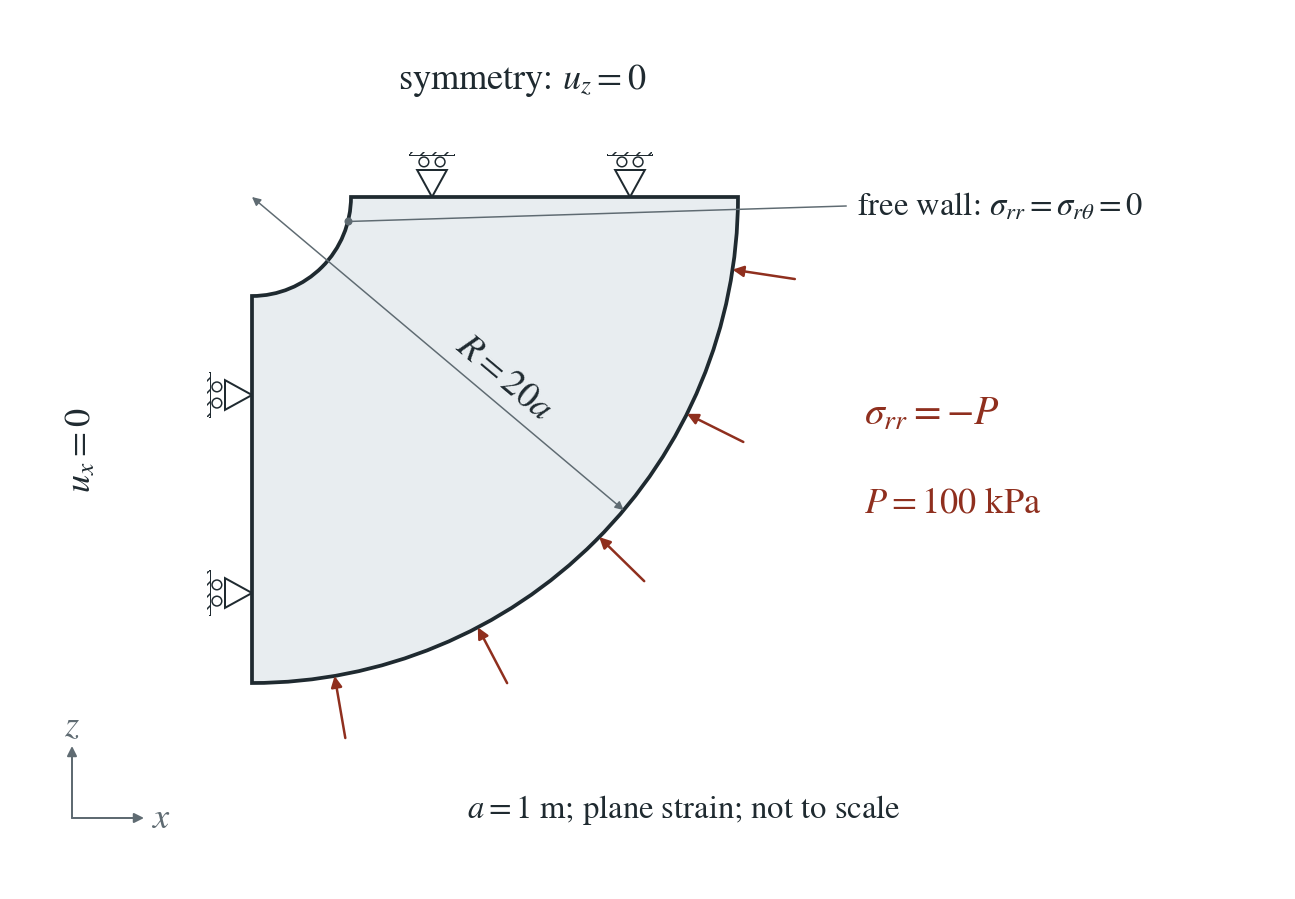
Geometry and load. A quarter annulus has opening radius a = 1 m and outer radius R = 20a. The opening is free; the outer curved face carries isotropic compressive traction P = 100 kPa.
Constraints. The two straight symmetry cuts have zero normal displacement. This is a dry plane-strain problem with gravity and transport disabled.
Material and comparison. K = G = 1 GPa. Stress and strain are compared over with the finite-annulus reference; the analytical curve remains visible and DES markers are thinned for display.
Input and how to run
Every file this example needs is in kirsch.zip. Run from that folder:
# Meshes the quarter annulus from annulus.poly (shipped alongside) at 0.025 m inner spacing, solves one quasi-static step to equilibrium and writes kirsch.save.* and kirsch.chkpt.*, with kirsch.info listing the frames.
dynearthsol2d input.cfg
Settings that define this example
| Setting | Value | What it does here |
|---|---|---|
mesh.meshing_option | 90 | 90: mesh the polygon read from poly_filename |
mesh.poly_filename | annulus.poly | annulus.poly: quarter annulus a = 1 m to R = 20 m; its boundary flags make the vertical cut x0, the opening x1, the horizontal cut z0 and the outer arc z1 |
mesh.resolution | 0.025 | 0.025 m element size, the finest mesh of the study |
mesh.min_angle | 28 | 28°, keeps triangles well shaped along the curved boundaries |
bc.stress_bc_z1 | 4 | type 4: normal stress on facets of any orientation, here the curved outer arc |
bc.stress_val_z1 | -100000.0 | P = 100 kPa isotropic compression on the outer arc (tension positive, so negative) |
bc.vbc_x1 | 0 | 0: the opening (flag x1) is free |
bc.vbc_z0 | 1 | 1: zero normal displacement on the horizontal symmetry cut (the vertical cut x0 uses the default 1) |
mat.rheology_type | elastic | elastic |
mat.bulk_modulus | [1e9] | K = 1 GPa |
mat.shear_modulus | [1e9] | G = 1 GPa |
mat.is_plane_strain | true | 2D plane strain; the out-of-plane stress σyy is not zero |
control.gravity | 0 | no gravity: the outer traction is the only load |
sim.max_steps | 1 | 1: one step solved to equilibrium by PT is the static answer |
input.cfg holds all 46 settings that differ from DES’s defaults; dynearthsol2d -h lists every option with its default.
Output
See Running the examples for output files, the Python reader and ParaView conversion.
| Field | What to look at |
|---|---|
stress | element stress, rotated to radial and hoop components and compared over 1.1a ≤ r ≤ 5a in panel (a) |
strain | element strain, rotated to radial and hoop components in panel (b) |
Result: DES and the analytical solution
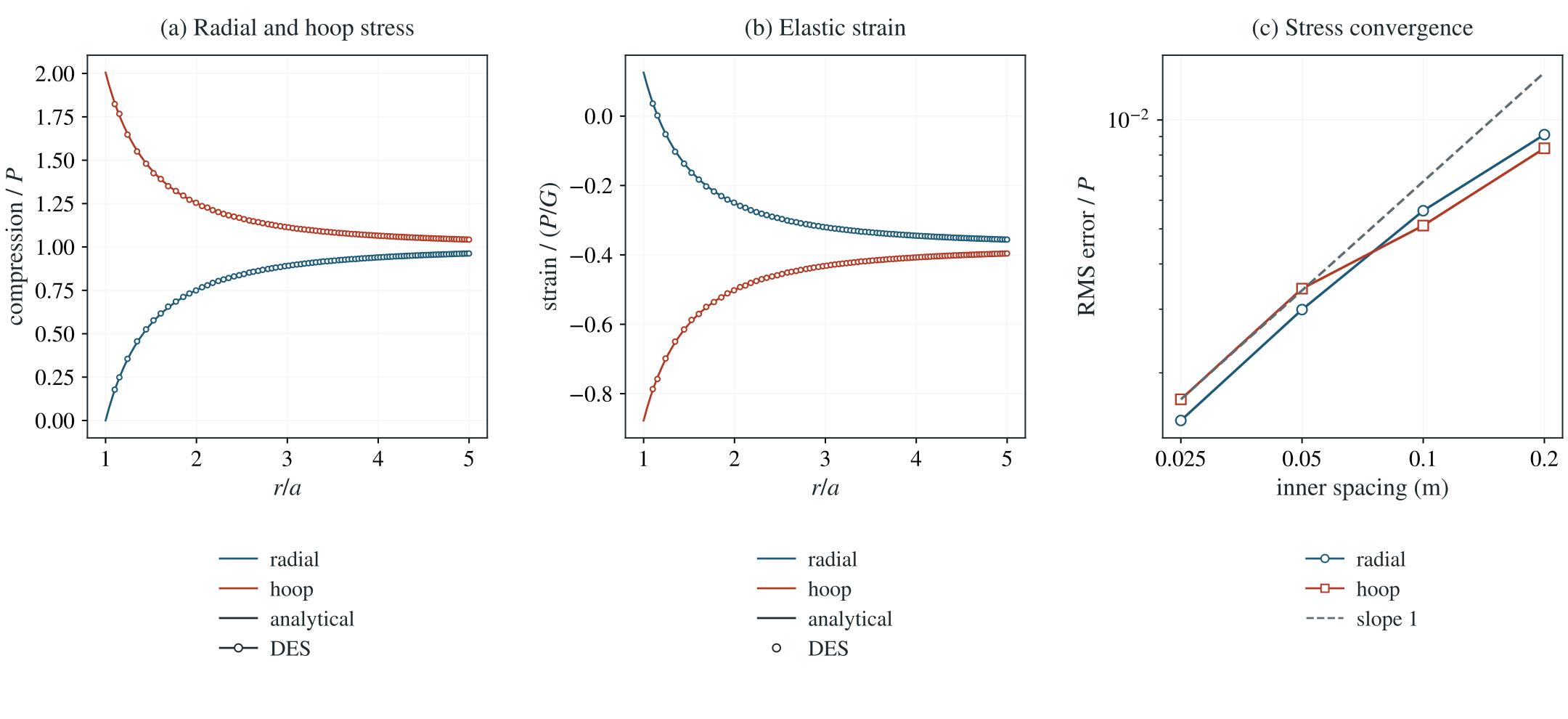
(a) Radial and hoop compression, scaled by P, against distance from the opening centre: lines, the finite-annulus solution; symbols, DES elements (thinned for display). (b) Radial and hoop elastic strain, scaled by P/G. (c) RMS stress error, scaled by P, against the inner mesh spacing.
This checks dry elastic stress, strain, curved-surface traction and symmetry constraints. Plasticity and excavation history remain separate checks; poroelastic injection is on the borehole page.
To reproduce the whole study behind this figure, from the DES source folder:
python3 benchmarks/poromechanics/kirsch_reference.py
python3 tests/functional/hydromechanics/check_kirsch.py dynearthsol2d OUT --spacings .2 .1 .05 .025
The study’s full numbers: record.json.
Analytical reference
Stress and displacement are tension/outward positive; is the out-of-plane stress. . Displacement is measured from an unloaded annulus, rather than from a precompressed excavation state.
Derivation
Radial equilibrium and the isotropic plane-strain Hooke law give the displacement . The boundary stresses determine the two integration constants.
Substitute zero radial stress at the opening and -P at the outer wall. As the wall moves to infinity, the finite solution approaches the isotropically loaded Kirsch limit.
Finite-annulus solution derived from radial equilibrium; evaluated and checked in kirsch_reference.py and check_kirsch.py.
Validity and limits
Isotropic, small-strain, dry elasticity. The finite outer wall changes the opening hoop stress by 0.251% relative to infinite-domain Kirsch. Anisotropic loading, plasticity, excavation history and poroelastic injection remain separate tests.