Maxwell stress build-up in pure shear
A Maxwell material loaded at a constant strain rate first responds elastically, then its stress approaches the viscous value over the Maxwell time . This benchmark shortens a square of Maxwell material in pure shear and compares the stress with that response. It uses DES's explicit mechanics with mass scaling, not the PT solver; for PT see Maxwell creep under a held load.
| Dimension | 2D |
| Build | make ndims=2 |
| Run time | about 7 minutes, 8 threads (2.2 million steps) |
| Inputs | benchmarks/mechanics/maxwell/maxwell.cfg in the DynEarthSol repository |
| Checked with | DynEarthSol 68cc2a0 |
Setup
| Setting | Value |
|---|---|
| Domain | 1 m × 1 m, element size 0.05 m (441 elements) |
| Loading | the right side moves inward and the base moves down, each at m/s; the left side and the top cannot move normal to themselves |
| Material | rheology_type = maxwell, = 10 GPa, = 1000 GPa (nearly incompressible), Pa s, so s |
| Mechanics | explicit, inertial_scaling = 1e6, characteristic_speed = 1e-14 |
| Duration | s, three Maxwell times, a frame every steps |
The input uses standard velocity conditions (vbc_x1 = 1,
vbc_val_x1 = -1e-14, vbc_z0 = 1, vbc_val_z0 = -1e-14) and stops at
max_time_in_yr = 95000. Earlier versions of this input used a boundary
type that needed a source patch.
With the side lengths and , the strain rates are and , and the stress difference of a Maxwell material obeys
The reference integrates this equation. Its limit is MPa in magnitude.
Input and how to run
cd benchmarks/mechanics/maxwell
../../../dynearthsol2d maxwell.cfg
What to look for
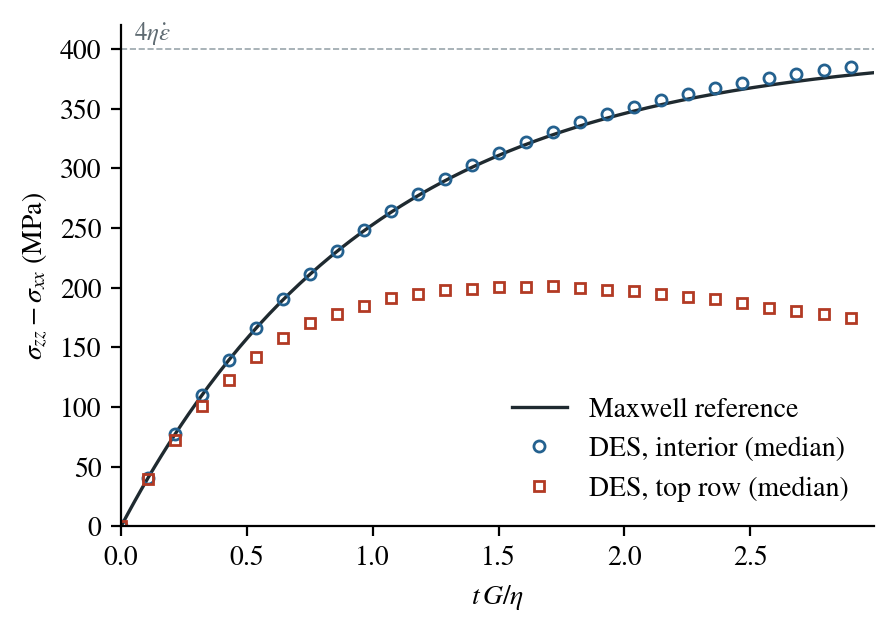
| DES | Reference | |
|---|---|---|
| Interior elements (median), after | 387 MPa | 380 MPa |
| Largest relative difference after , interior median | 1.9 % | |
| Top element row (median), after | 172 MPa | 380 MPa |
The elements below the top row follow the Maxwell response: the stress rises elastically, bends over after about one Maxwell time and approaches . Their median stays within 2 % of the reference; individual interior elements scatter by up to about ±15 % at the end.
The 29 elements that touch the top surface do not. Their stress stops rising after about 1.5 Maxwell times and then falls; they shorten by about 40 % of the imposed strain. Exchanging the roles of top and base, holding the base and moving the top up, gives the same result: only the row at the top surface lags. The cause is not identified; the behaviour is reported here as found.
Limits
- Top surface. As described above, the top element row departs from the homogeneous solution; compare the interior only.
- Explicit mechanics only. The PT solver is checked separately in Maxwell creep under a held load.