Elastoplastic oedometer test
An oedometer shortens a sample in one direction while its other sides cannot move. The strain is uniaxial, so the stress follows a closed-form path: elastic up to yield, then a straight plastic branch whose slope depends on the friction and dilation angles. This benchmark checks DES's Mohr–Coulomb return on that path.
| Dimension | 2D, plane strain |
| Build | make ndims=2 |
| Run time | about 1 s |
| Inputs | benchmarks/mechanics/oedometer/oedometer-2d.cfg in the DynEarthSol repository |
| Checked with | DynEarthSol cd1042c |
Setup
| Setting | Value |
|---|---|
| Cell | 1 m × 1 m, two triangles, plane strain (is_plane_strain = yes) |
| Loading | the right side moves inward at m/s; the left, top and bottom sides cannot move normal to themselves |
| Elasticity | MPa |
| Strength | cohesion = 1 MPa, friction angle = 10°, dilation angle = 10°, no softening, tension cut-off 5.67 MPa |
| Other | no gravity; fixed time step 1 s, 2000 steps (20 mm of shortening) |
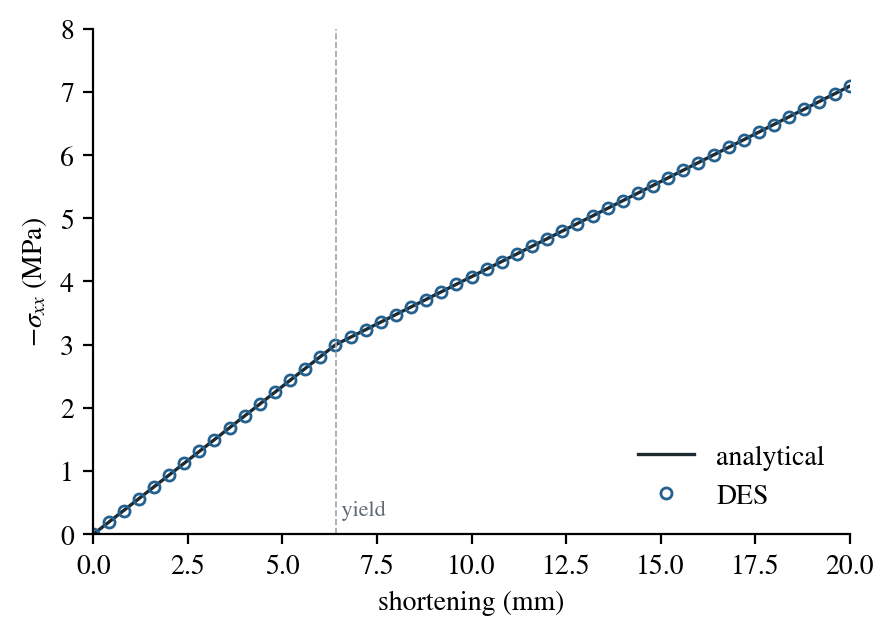
With and , the axial stress rises elastically as and the lateral stresses as . With , the cell yields at
here after 6.41 mm of shortening. Both lateral stresses are equal, so the return lies on the edge of two Mohr–Coulomb faces. With the plastic branch has slope
The reference evaluates this path at the true strain DES applies, with the shortening at the start of each step, because DES updates the cell's geometry every step.
Input and how to run
cd benchmarks/mechanics/oedometer
../../../dynearthsol2d oedometer-2d.cfg
The run writes 51 frames, result.save.*, one every 40 steps.
benchmarks/mechanics/oedometer/oedometer-2d-plot.py plots the shortening of the right side
against with a reference path; it was written for an older
Matplotlib and needs small changes to run with a current one. Its path takes
each step's strain at the end-of-step shortening and changes slope only at a
whole step, which puts its final stress 0.03 % above the closed form.
What to look for
| DES | Reference | |
|---|---|---|
| Axial stress after 20 mm | 7.0868 MPa | 7.0864 MPa |
| Largest relative difference, elastic branch | 0.017 % | |
| Largest relative difference, plastic branch | 0.014 % |
DES follows the path on both branches. The two elements carry the same stress, so the cell deforms uniformly, as the reference assumes.
Limits
- One stress path. Uniaxial strain tests the two-face edge return and the dilation angle, but not the apex or the tension cut-off.
- No softening. Cohesion and friction stay constant; see the shear-band benchmark for softening.