Open boundaries: a draining pressure pulse
A smooth pressure pulse drains through two zero-pressure ends while the side faces remain sealed.
Maximum pressure error: 0.0424% of the initial amplitude; storage error 0.0509%. Stored fluid plus outflow equals the initial volume within 1.19e-21 m³ (independent integration).
| Dimension | 3D |
| Build | make ndims=3 from the poromechanics source (not yet merged; DynEarthSol #134) |
| Inputs | open-flow.zip |
| Reproduce with | DynEarthSol 3774df0 |
Problem setup
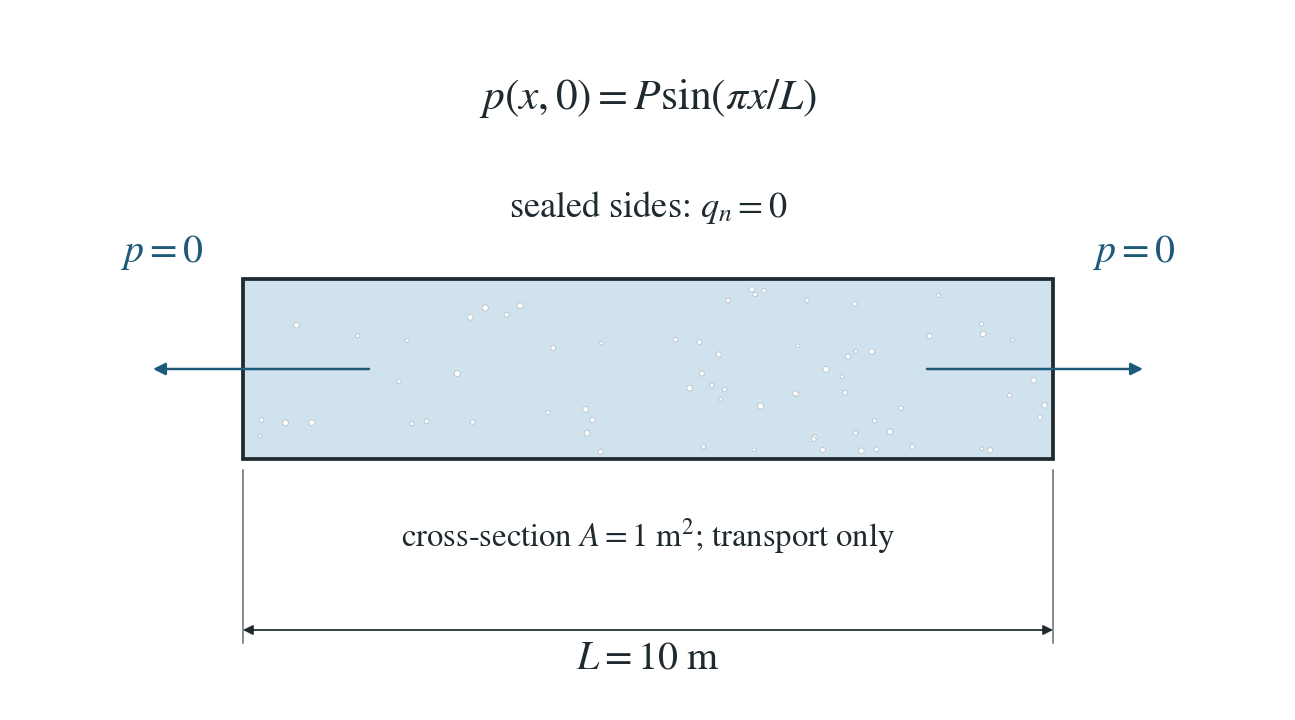
Geometry. A 10 m column has a 1 m² cross-section. Both end faces hold zero pressure; the lateral faces are sealed.
Initial condition. Pressure is , with Pa and m. The run restarts from the shipped seed checkpoint, whose frame 0 holds this field.
Material and mechanics. Diffusivity is 1 m²/s and pressure capacity is constant. Mechanical pressure feedback, gravity and heat are disabled.
Input and how to run
Every file this example needs is in open-flow.zip. Run from that folder:
# Restarts from the shipped seed.save.000000, seed.chkpt.000000 and seed.info, whose frame 0 holds the initial sine pulse, and runs 200 steps of 0.05 s to 10 s. DES writes a pulse.save.* frame at every step. To build the seed yourself, run the study command: it runs one step, then writes the pulse into frame 0.
dynearthsol3d input.cfg
Settings that define this example
| Setting | Value | What it does here |
|---|---|---|
sim.is_restarting | true | starts from a saved state instead of the built-in initial condition |
sim.restarting_from_modelname | seed | the shipped seed files, which hold the sine pulse |
sim.restarting_from_frame | 0 | frame 0 of the seed, the initial pulse |
sim.max_steps | 200 | 200 steps of 0.05 s, to 10 s |
sim.output_step_interval | 1 | a frame at every step, so every step enters the pressure, storage and budget checks |
control.has_hydraulic_diffusion | true | turns on Darcy flow of pore pressure |
control.has_poroelastic_pressure_feedback | false | off: deformation does not change the pressure, so storage stays constant |
control.gravity | 0 | no gravity, so the pulse drains by diffusion alone |
control.fixed_dt | 0.05 | outer step of 0.05 s; DES splits it into stable flow substeps by itself |
bc.hbc_x0 | 2 | type 2: the end face x = 0 is held at the pressure in bc.hbc_pressure, here 0 |
bc.hbc_x1 | 2 | type 2: the end face x = 10 m is also held at 0; the other faces are sealed (type 0) |
mat.porosity | [0.25] | with the fluid bulk modulus, sets the constant storage |
mat.hydraulic_perm | [1.1463636364386364e-13] | chosen so that the diffusivity is 1 m²/s |
mat.bulk_modulus | [1000000000000.0] | very stiff skeleton (1e12 Pa), so the solid barely moves |
input.cfg holds all 46 settings that differ from DES’s defaults; dynearthsol3d -h lists every option with its default.
Output
See Running the examples for output files, the Python reader and ParaView conversion.
| Field | What to look at |
|---|---|
pore pressure | pressure along the column axis, compared with the decaying sine, and summed with element volumes for the stored fluid |
coordinate | x position of each node and element volumes for the stored fluid |
fluid balance | five numbers per frame for the last step, in m³: storage, mechanics, wells, boundary exchange and residual; the boundary entry, summed over steps, is the outflow in (b) |
Result: DES and the analytical solution
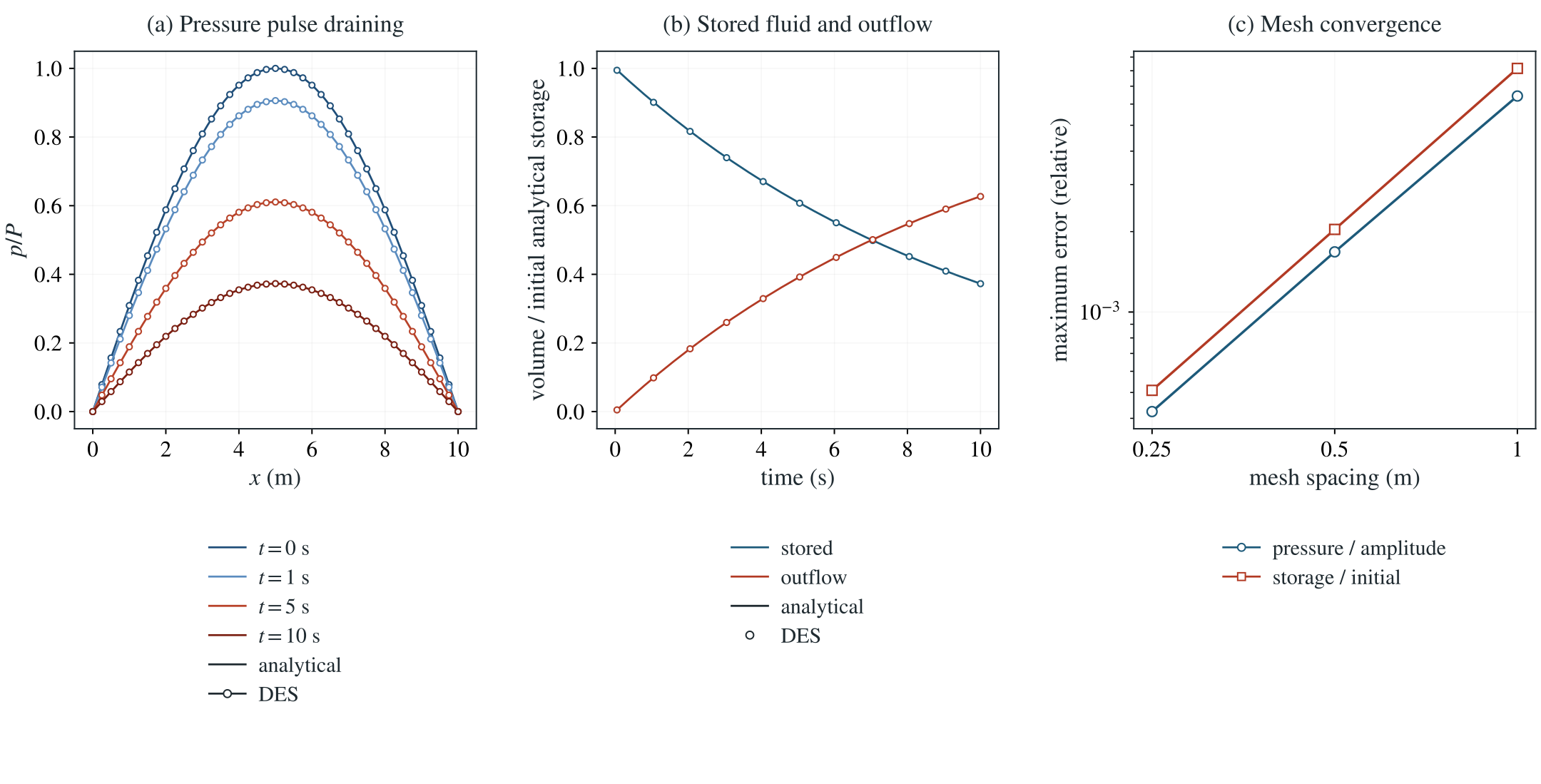
(a) Pressure p/P along the column axis at 0, 1, 5 and 10 s: DES nodes (circles) and the decaying sine (lines). (b) Stored fluid and cumulative outflow, each divided by the initial analytical storage M_0: DES (circles; stored fluid from pressure and element volumes, outflow from the boundary term of the fluid balance) against the exponential reference (lines). (c) Maximum pressure error relative to P and stored-volume error relative to M_0 against mesh spacing.
This checks drainage through open boundaries and the global water budget: stored water plus outflow stays equal to the initial volume. Storage is constant here; unsaturated coupling, changing storage and remeshing are not covered.
To reproduce the whole study behind this figure, from the DES source folder:
python3 tests/functional/hydromechanics/check_open_flow.py dynearthsol3d OUT --spacings 1 0.5 0.25
The study’s full numbers: record.json.
Analytical reference
and are fluid volumes, in m³. is positive for outward drainage. Stored fluid is computed from the element volumes and nodal pressures, independently of DES’s own fluid balance.
Derivation
The sine is the first eigenfunction of the diffusion equation with zero pressure at each end. Separation of variables supplies its exponential decay.
Integrating the sine over the column gives the stored volume. Darcy outflow at the two ends supplies its equal and opposite loss.
Separation-of-variables solution of the stated diffusion problem; pressure, storage and the boundary budget of every time step are checked in check_open_flow.py.
Validity and limits
Constant-capacity saturated flow on a fixed mesh. Variable storage, unsaturated coupling, deforming volume and remapping need separate open-system fluid budgets.