Theis pumping and recovery in a confined aquifer
A well pumps a confined aquifer and then shuts in. The drawdown spreads radially and recovers.
Largest drawdown error: 0.079% of , over m and eight times through pumping and recovery.
| Dimension | 3D |
| Build | make ndims=3 from the poromechanics source (not yet merged; DynEarthSol #134) |
| Inputs | theis.zip |
| Reproduce with | DynEarthSol 3774df0 |
Problem setup
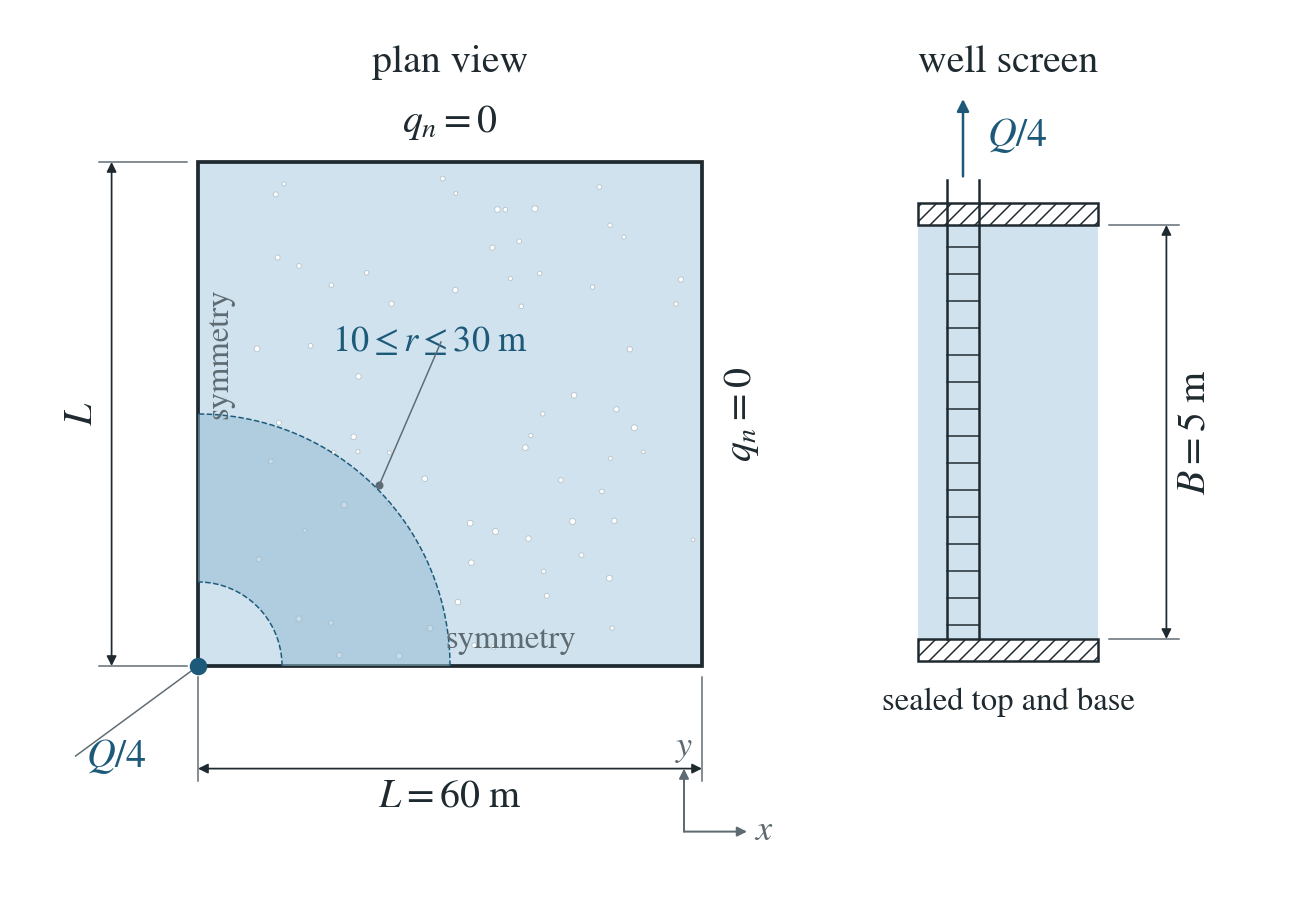
Geometry and well. A quarter box, m, of thickness m. A fully penetrating well on the corner edge pumps , a quarter of the total rate , for 80 s and then shuts in for 80 s.
Boundaries and mechanics. All faces are sealed; the symmetry planes , make the corner well radial. The far sides stay beyond the drawdown: its reference value there is below of the pressure scale. The skeleton is stiff and mechanical pressure feedback is off, so the storage is the fixed-stress value .
What is compared. The pressure drawdown at every node with m, at eight times through pumping and recovery, against the superposed Theis solution. Errors are fractions of .
Input and how to run
Every file this example needs is in theis.zip. Run from that folder:
# Runs the 3D quarter box: 80 steps of 2 s, the well pumping for the first 80 s and shut in for the last 80 s. DES writes theis.save.* frames every 10 steps (20 s); frame 0 is the initial state.
dynearthsol3d input.cfg
Settings that define this example
| Setting | Value | What it does here |
|---|---|---|
control.has_hydraulic_diffusion | true | turns on Darcy flow of pore pressure; wells need it |
control.has_poroelastic_pressure_feedback | false | off: deformation does not change the pressure, so the storage stays at the fixed-stress value S_B and pressure obeys the Theis diffusion equation |
control.gravity | 0 | no gravity, so there is no hydrostatic gradient and the drawdown is compared directly in pressure |
control.fixed_dt | 2.0 | physical step of 2 s; DES splits it into stable flow substeps by itself |
sim.max_steps | 80 | 80 steps of 2 s end the run at 160 s: 80 s of pumping and 80 s of recovery |
sim.output_step_interval | 10 | a frame every 10 steps (20 s), so eight frames are compared with Theis |
bc.num_wells | 1 | one rate-controlled vertical well |
bc.well_x | [0.0] | with bc.well_y, puts the well on the corner edge x = y = 0; the sealed symmetry planes make it one quarter of a full well |
bc.well_rate | [2.5e-05] | extraction rate of the quarter well, Q/4 with Q = 1e-4 m³/s, spread uniformly over the 5 m screen |
bc.well_schedule_time_in_yr | [0.0, 2.5351011628062854e-06, 2.5351011628062854e-06] yr = [0, 80, 80] s | schedule times 0, 80 s, 80 s (in years); the repeated time makes a step change at 80 s |
bc.well_schedule_ratio | [1, 1, 0] | rate multipliers 1, 1, 0: full rate until 80 s, then shut in |
mat.bulk_modulus | [1000000000000.0] | very stiff skeleton (1e12 Pa), so the mechanical storage α²/K is negligible and the solid barely moves |
mat.porosity | [0.25] | with the fluid bulk modulus, sets the pressure storage φ/K_f of the aquifer |
mat.hydraulic_perm | [1.1463636364386364e-13] | chosen so that the pressure diffusivity κ/(μS_B) is 1 m²/s |
input.cfg holds all 50 settings that differ from DES’s defaults; dynearthsol3d -h lists every option with its default.
Output
See Running the examples for output files, the Python reader and ParaView conversion.
| Field | What to look at |
|---|---|
pore pressure | drawdown s_p = p(frame 0) − p at every node, compared with Theis at nodes 10–30 m from the well |
coordinate | gives the radius r = √(x²+y²) of each node from the well axis |
connectivity | with the coordinates, gives element volumes for the closed-box water budget against the pumped volume |
Result: DES and the analytical solution
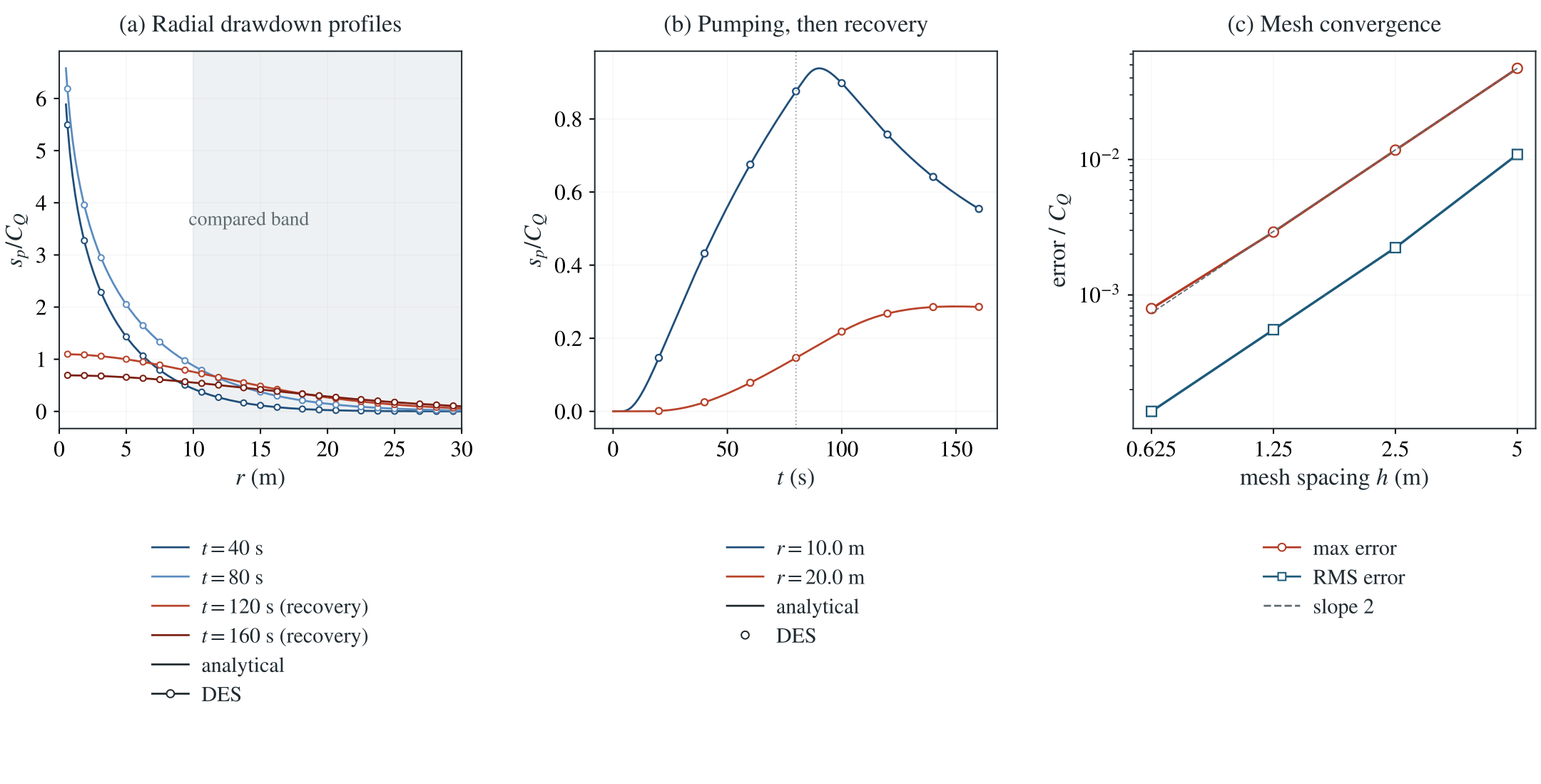
(a) Radial drawdown profiles s_p/C_Q on the y = 0 symmetry plane at four saved times, two during pumping and two during recovery: DES nodes (circles) and the Theis solution with the shut-in superposed (lines). The shaded band is the compared range 10 ≤ r ≤ 30 m. (b) Drawdown history at r ≈ 10 m and r ≈ 20 m through pumping and recovery; the dotted line marks shut-in. (c) Maximum and RMS drawdown error over the compared nodes and times against mesh spacing, with a slope-2 guide.
The closed-box water budget differs from the prescribed pumping integral by at most 2.34e-17 m³. This checks the rate-controlled well, hydraulic storage and radial diffusion, including shut-in superposition. Mechanical pressure feedback is disabled in this flow-isolation test.
To reproduce the whole study behind this figure, from the DES source folder:
python3 tests/functional/hydromechanics/check_theis.py dynearthsol3d OUT --spacings 5 2.5 1.25 0.625
The study’s full numbers: record.json.
Analytical reference
is pressure drawdown in Pa and the drawdown of a unit-rate well. has units , has units , and is total discharge in . Here . Disabling mechanical pressure feedback retains the selected fixed-stress storage . Terms are zero before each rate change at time . This pressure formulation remains valid at zero gravity; it uses no conversion from pressure to head.
Derivation
Away from the well, integrate pressure diffusion through thickness and use zero initial drawdown. The inward discharge at supplies the line-sink boundary. Integrating the radial diffusion Green function in time gives .
Differentiate the solution to check the well limit. Storage inside an observation circle supplies the remaining discharge; linearity permits pumping/shut-in and multiwell superposition.
Theis (1935), evaluated with the exponential integral in theis_reference.py; the same module superposes changes of rate.
Validity and limits
Confined, homogeneous, isotropic aquifer with constant properties; a line well without wellbore storage; the singular axis m is excluded. Pressure only: the stiff skeleton removes poroelastic coupling, which the averaged-aquifer page addresses.