Water balance through plastic yielding
A sealed porous column is compressed through Mohr–Coulomb yield. Total volume change fixes its mean pressure independently of the plastic stress return.
Through yield, the stored fluid content plus the pressure increment still pending in the PT step equals the imposed volume loss to round-off, and the mean pressure follows its reference recurrence to round-off.
| Dimension | 2D |
| Build | make ndims=2 from the poromechanics source (not yet merged; DynEarthSol #134) |
| Inputs | plastic-content.zip |
| Reproduce with | DynEarthSol 3774df0 |
Problem setup
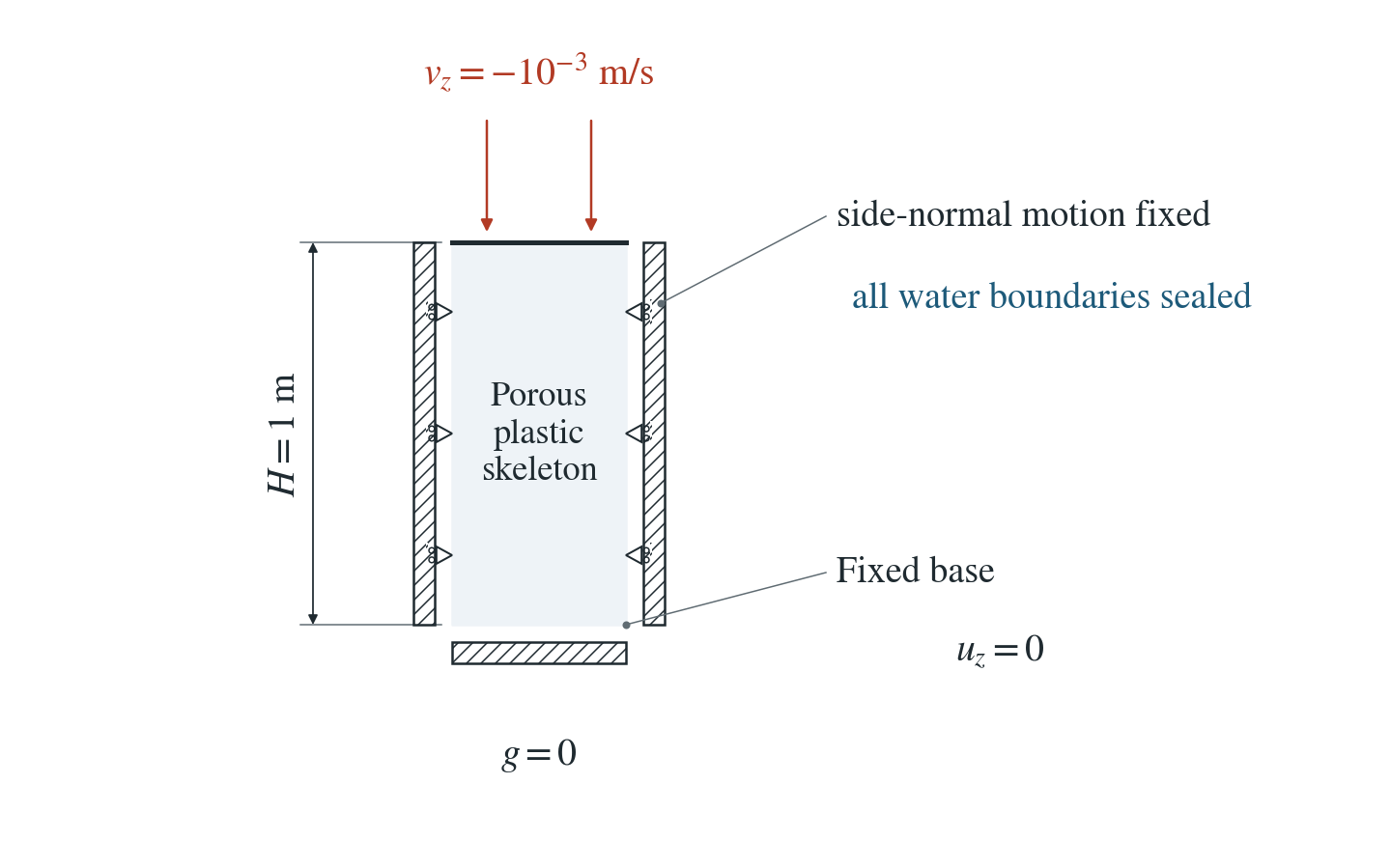
Geometry and motion. Unit column with a fixed base and fixed side-normal motion. The top moves down at 0.001 m/s for 1 s. Plane strain in 2D; zero gravity and a fixed mesh.
Water boundaries. All boundaries are sealed in the selected case. Initial pressure is zero; porosity and pressure capacity remain fixed.
Yield law. Mohr–Coulomb: cohesion 100 Pa, friction 20° and selected dilation 10°. Other controls use zero and negative dilation.
Input and how to run
Every file this example needs is in plastic-content.zip. Run from that folder:
# Compresses the 2D column for 100 steps of 0.01 s (1 s) and writes column.save.* and column.chkpt.* at every step, with column.info listing the frames.
dynearthsol2d input.cfg
Settings that define this example
| Setting | Value | What it does here |
|---|---|---|
mat.rheology_type | elasto-plastic | elasto-plastic: Mohr–Coulomb plasticity |
mat.cohesion0 | [100] | cohesion 100 Pa (equal to cohesion1: no weakening), small so the column yields early |
mat.friction_angle0 | [20] | friction angle 20° (friction_angle1 is the same) |
mat.dilation_angle0 | [10] | dilation angle 10° (dilation_angle1 is the same): yielding makes the skeleton dilate |
bc.vbc_val_z1 | -0.001 | the top moves down at 1 mm/s; base and sides are held normally, so the volume loss is fixed by this velocity |
mat.hydraulic_perm | [0] | zero permeability, and every hbc is 0 (no flow): the column is sealed |
mat.fluid_bulk_modulus | [1000000.0] | K_f = 1 MPa, a soft fluid, so the pressure stays small (4 kPa at 1 s) |
mat.porosity | [0.25] | φ = 0.25; with K_f it gives the storage φ/K_f |
mat.bulk_modulus_s | [1e+20] | grain modulus 1e20 Pa: incompressible grains, Biot coefficient 1 |
mat.bulk_modulus | [20000000.0] | K = 20 MPa |
mat.shear_modulus | [10000000.0] | G = 10 MPa |
control.has_PT | true | PT solves the mechanics to equilibrium every step; the pressure increment it carries to the next step is counted separately |
control.fixed_dt | 0.01 | 0.01 s step; 100 steps to 1 s |
mat.is_plane_strain | true | 2D plane strain, including the out-of-plane plastic strain |
input.cfg holds all 62 settings that differ from DES’s defaults; dynearthsol2d -h lists every option with its default.
Output
See Running the examples for output files, the Python reader and ParaView conversion.
| Field | What to look at |
|---|---|
pore pressure | nodal pressure; its volume average is the mean pressure in panel (a) and gives the pressure part of the stored water |
strain | element strain; its volumetric part integrated over the mesh is the imposed volume loss |
plastic strain | shows that the column has yielded before the balance is checked |
fluid balance | per-step water ledger; its boundary entry stays zero in this sealed column |
Result: DES and the analytical solution
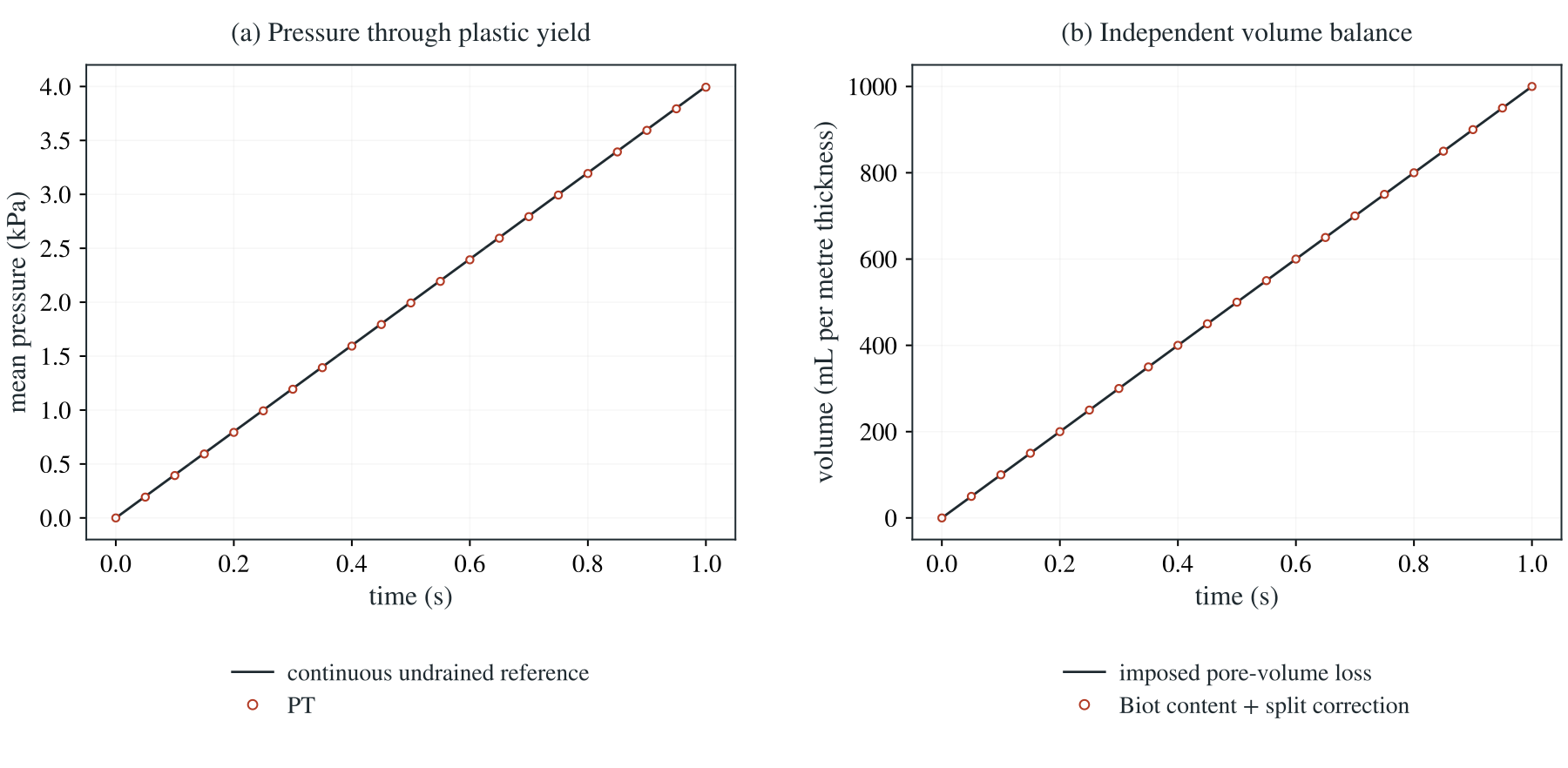
(a) Mean pore pressure of the sealed column against time, through yield: line, the undrained reference set by the imposed volume loss; symbols, DES. (b) Volume balance: line, the imposed pore-volume loss; symbols, DES water stored by pressure plus the pressure increment still pending in the PT step.
This checks that plastic yielding neither creates nor destroys pore water: the fluid source uses the accepted volume change, not an elastic estimate. Forty-eight cases cover 2D and 3D, negative, zero and positive dilation, hydraulic substeps, open drainage, Gardner suction, EP-RSF with evolving pressure and thermal expansion. Remeshing, porosity change from plastic strain and the general energy balance are not covered.
History CSV · Control tables
To reproduce the whole study behind this figure, from the DES source folder:
python3 tests/functional/hydromechanics/check_plastic_content.py dynearthsol2d OUT/2d
python3 tests/functional/hydromechanics/check_plastic_content.py dynearthsol3d OUT/3d --ndims 3
The study’s full numbers: record.json.
Analytical reference
MPa, MPa, , , MPa and Pa. m/s and m. is the previous raw pressure increase consumed by mechanics. The physical pressure reaches 4 kPa at 1 s; the 0.01 s PT step leaves about 0.17% pending lag.
Derivation
Integrate total volumetric strain over the actual mesh. The imposed boundary velocity fixes the volume loss even after the stress return becomes plastic.
Sealed linear Biot conservation gives the physical mean pressure. Adding the separately recorded pending-pressure contribution gives the exact PT recurrence shown above.
Converting the stress change back to volume with the elastic moduli fails after a plastic return, including the out-of-plane plastic strain in plane strain. DES’s fixed-stress source therefore uses the accepted volumetric strain of the step and the previous raw pressure increment; pressure substeps reuse the same accepted mechanical history.
With thermal expansion the direct strain source uses the full thermal fluid coefficient, without an additional elastic stress conversion.
The partly saturated homogeneous Gardner control has an independent scalar content inversion at each accepted step. It checks the implemented retention-rate law; it does not establish a finite-strain porosity law.
Additional EP-RSF controls check the independent aging update and effective-stress return while pressure evolves. Open drains include measured boundary exchange; they check material content, rather than a separate spatial Darcy-flux solution.
Integral Biot conservation with prescribed boundary motion; independent scalar pressure recurrence and local effective-stress/thermal controls in check_plastic_content.py.
Validity and limits
Fixed porosity and geometry. The pending PT term is a numerical coupling lag, not physical water. Porosity change from plastic strain (including enhancement and healing), remeshing, the energy balance of open systems and shear heating are not covered.