Pressure-driven yielding of a confined layer
Rising pore pressure lowers the effective stress until the ground yields, the mechanism of injection- and rainfall-induced failure. In a laterally confined layer the yield pressure at each depth is exact, so a yield front moving down can be compared element by element.
On the 0.025 m mesh with 6400 steps every element yields within 0.23% (mean 0.15%) of its exact pressure, and 96 of 160 elements yield, as predicted. DES always yields slightly late; the delay falls with both the step and the mesh.
| Dimension | 2D |
| Build | make ndims=2 from the poromechanics source (not yet merged; DynEarthSol #134) |
| Inputs | pressure-yield.zip |
| Reproduce with | DynEarthSol 3774df0 |
Problem setup
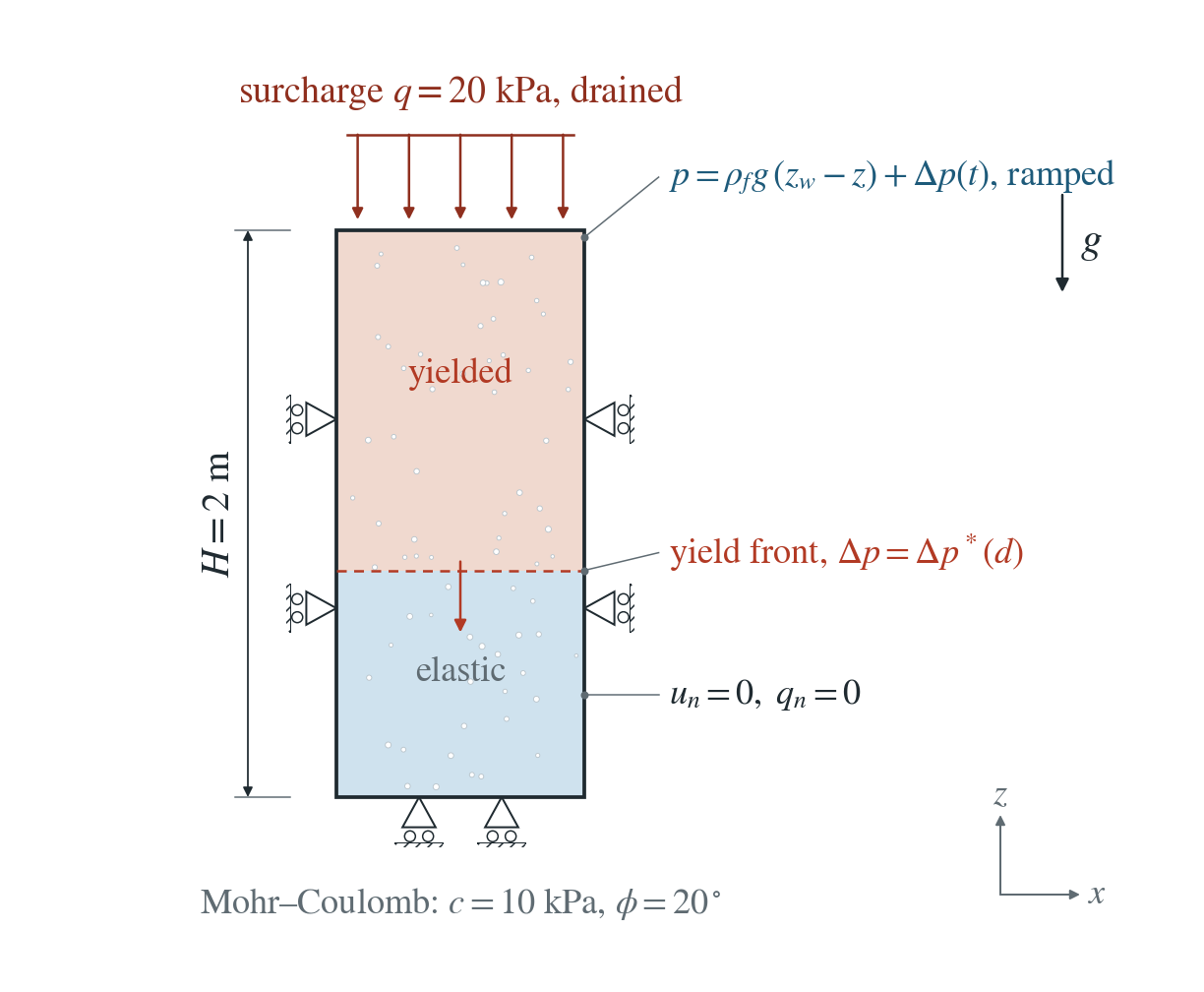
Layer. A saturated layer m deep under a drained surcharge kPa, water table at the top, an isotropic lithostatic initial stress with hydrostatic pressure. Sides and base are fixed normally and sealed.
Loading. The top pressure rises linearly over 2000 s to 95% of the apex pressure; permeability is high, so the whole layer follows. Gravity acts; pressure feedback is on.
Material. Elastic–perfectly plastic Mohr–Coulomb: MPa, MPa, kPa, , no dilation, , .
What is compared. For each element, the pressure rise at the first step with plastic strain against the exact onset at its centroid depth.
Input and how to run
Every file this example needs is in pressure-yield.zip. Run from that folder:
# Runs the 2D layer (one 0.025 m element wide, 2 m deep) for 6400 steps of 0.3125 s (2000 s) and saves every step to layer.save.*, with layer.info listing the frames; it first brings the layer to gravitational equilibrium.
dynearthsol2d input.cfg
Settings that define this example
| Setting | Value | What it does here |
|---|---|---|
mat.rheology_type | elasto-plastic | elasto-plastic: elastic–perfectly plastic Mohr–Coulomb (dilation stays at its default of zero) |
mat.cohesion0 | [10000.0] | cohesion c = 10 kPa (cohesion1 equal: no weakening) |
mat.friction_angle0 | [20.0] | friction angle φ = 20° (friction_angle1 equal) |
bc.stress_bc_z1 | 3 | type 3: vertical traction on the top surface |
bc.stress_val_z1 | -20000.0 | the surcharge q = 20 kPa (compression negative), which keeps the yielded top in compression |
bc.hbc_z1 | 2 | type 2: the top pore pressure is prescribed from hbc_pressure |
bc.hbc_pressure | [0,0,0,0,0,45101.03548481891] | the z1 (top) entry is the final top pore pressure, 95% of the pressure that would bring the surface to the apex of the yield cone |
bc.num_hbc_schedule | 2 | two schedule points for the prescribed pressure |
bc.hbc_schedule_time_in_yr | [0, 6.337752907015714e-05] yr = [0, 2000] s | 0 and 2000 s: the top pressure ramps linearly over the run |
bc.hbc_schedule_ratio | [0, 1] | 0 to 1: the ramp starts from the hydrostatic state |
mat.hydraulic_perm | [1e-11] | high permeability, so the whole layer follows the top pressure rise almost at once |
control.gravity | 9.81 | 9.81 m/s²: lithostatic stress and hydrostatic pressure set the depth dependence of the yield pressure |
ic.has_body_force_adjustment | true | brings the initial stress into equilibrium with gravity before loading |
control.fixed_dt | 0.3125 | 0.3125 s; 6400 steps reach 2000 s |
input.cfg holds all 62 settings that differ from DES’s defaults; dynearthsol2d -h lists every option with its default.
Output
See Running the examples for output files, the Python reader and ParaView conversion.
| Field | What to look at |
|---|---|
pore pressure | element-averaged pressure; its rise since the start, read at the first saved step with plastic strain, is each element's yield pressure |
plastic strain | marks the first saved step at which an element has yielded |
stress | element total stress; with the pore pressure it gives the effective-stress paths in panel (b) |
Result: DES and the analytical solution
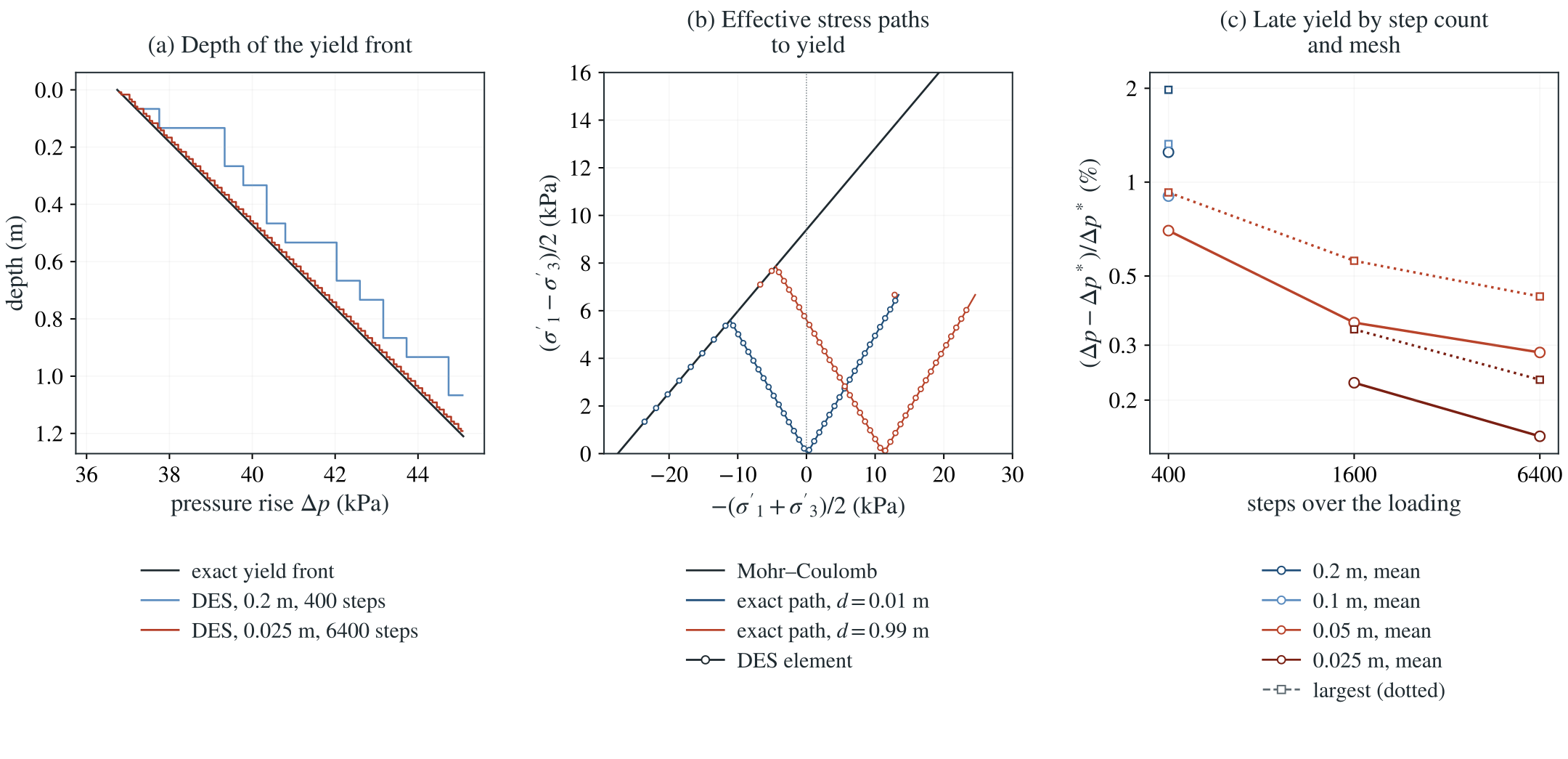
(a) Depth of the yield front against the pressure rise: line, the exact onset depth; stepped lines, DES on the coarsest mesh and on the finest mesh with the most steps. (b) Effective-stress paths to yield at two depths: lines, the exact paths up to the Mohr–Coulomb line; symbols, DES elements. (c) Mean error of the yield pressure for each mesh and number of steps.
This checks effective-stress plasticity in a boundary-value problem driven by pore pressure: the Biot coefficient in the effective stress, the Mohr–Coulomb return and the pressure coupling together.
To reproduce the whole study behind this figure, from the DES source folder:
python3 benchmarks/poromechanics/pressure_yield_reference.py
python3 tests/functional/hydromechanics/check_pressure_yield.py dynearthsol2d OUT/mesh --spacings 0.2 0.1 0.05 --steps 400
python3 tests/functional/hydromechanics/check_pressure_yield.py dynearthsol2d OUT/steps1600 --spacings 0.05 --steps 1600
python3 tests/functional/hydromechanics/check_pressure_yield.py dynearthsol2d OUT/pt1-steps1600 --spacings 0.05 0.025 --steps 1600 --pt-option 1
python3 tests/functional/hydromechanics/check_pressure_yield.py dynearthsol2d OUT/pt1-steps6400 --spacings 0.025 --steps 6400 --pt-option 1
The study’s full numbers: record.json.
Analytical reference
Tension positive; is depth, , and are the principal effective stresses. is the first root of the yield function of the elastic trial state.
Derivation
Under uniaxial strain the horizontal stresses stay equal and change by times the vertical change; the total vertical stress is fixed by the weight and the surcharge, so a uniform pressure rise moves only the effective stresses, as above.
increases with depth, so a yield front moves down. Each depth is independent under uniaxial strain, so the front stays exact after the layer above yields; the yielded state follows the cone until its apex.
The surcharge keeps the top in compression: without it the yielded top reaches the apex within a few kPa of the onset. pressure_yield_reference.py checks the onset on the yield surface, the elastic state just below it, the surcharge-free closed form and the ordering of onset and apex.
Terzaghi effective stress with Mohr–Coulomb yield; the uniaxial-strain stress path as in Jaeger, Cook and Zimmerman, Fundamentals of Rock Mechanics (2007). Computed in pressure_yield_reference.py.
Validity and limits
Uniaxial strain, a uniform pressure rise, no dilation, fully saturated. The test stops short of the apex, beyond which no equilibrium exists. 3D is checked only to onset; an inclined (infinite-slope) version needs an initial-stress option DES does not have.