Steady infiltration: van Genuchten law
A constant inflow from the top produces a steady suction profile above a water table at the base. The van Genuchten law has no air-entry pressure, so the soil desaturates as soon as the pressure falls below zero.
Largest pressure error: 5.69 Pa, 0.96% of the profile range.
| Dimension | 2D |
| Build | make ndims=2 from the poromechanics source (not yet merged; DynEarthSol #134) |
| Inputs | vg.zip |
| Reproduce with | DynEarthSol 3774df0 |
Problem setup
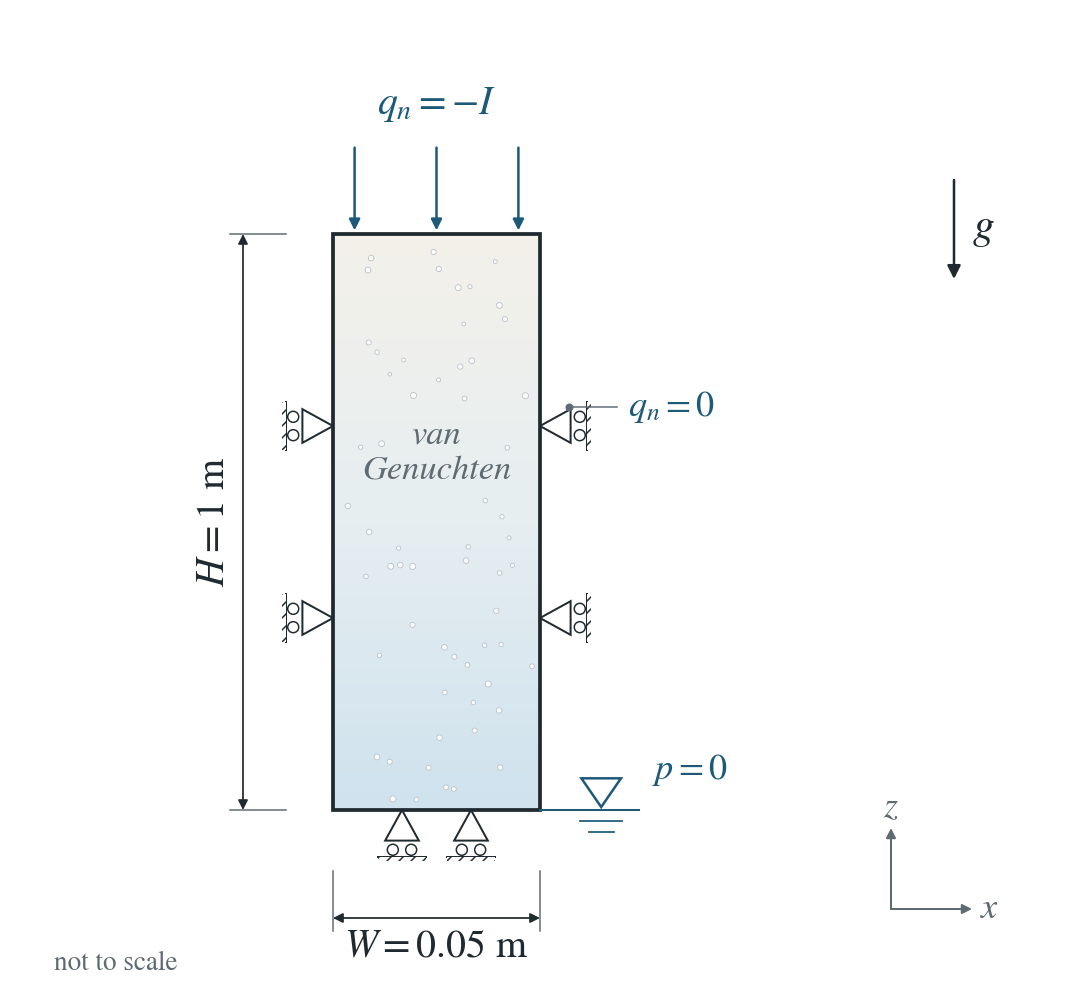
Water boundaries. Constant downward inflow m/s at the top. Base pressure zero; sides sealed.
Retention law. Pressure-based Pa, , residual saturation . Gravity points downward.
Mechanical conditions and comparison. Side-normal displacement and base vertical displacement fixed; traction-free top. Start hydrostatic and compare the final steady pressure profile.
Input and how to run
Every file this example needs is in vg.zip. Run from that folder:
# Runs the 2D column with fixed 300 s steps for about 23 days (2e6 s), long enough to reach the steady profile. DES writes column.save.* at the start, halfway and at the end; the page compares the last frame.
dynearthsol2d input.cfg
Settings that define this example
| Setting | Value | What it does here |
|---|---|---|
control.has_hydraulic_diffusion | true | turns on Darcy flow, here partly saturated (Richards) flow |
control.has_PT | true | PT solver: mechanical equilibrium is reached by iteration within each step |
control.gravity | 9.81 | gravity drives the downward flow and sets the hydrostatic start |
sim.max_time_in_yr | 0.06337752907015713 yr = 2e+06 s | about 2e6 s in fixed 300 s steps, long enough for the column to reach steady state |
sim.output_time_interval_in_yr | 0.031688764535078566 yr = 1e+06 s | a frame halfway and one at the end |
bc.hbc_z0 | 2 | type 2: the base is held at the pressure in bc.hbc_pressure, here 0, the water table |
bc.hbc_z1 | 3 | type 3: the top has the prescribed flux in bc.hbc_flux |
bc.hbc_flux | [0,0,0,0,0,-1.388888888888889e-06] | outward Darcy flux per face; the top value −1.389e-6 m/s is an inflow of half the saturated conductivity |
ic.water_table_z | -1.0 | starts hydrostatic with the water table at the base (z = −1 m) |
mat.retention_model | [1] | 1: van Genuchten retention with Mualem relative permeability (n is retention_n, default 2) |
mat.retention_alpha | [5e-4] | pressure-based retention parameter α_p = 5e-4 1/Pa |
mat.residual_saturation | [0.1] | residual saturation S_r = 0.1 |
mat.fluid_bulk_modulus | [40000.0] | deliberately small (4e4 Pa) to allow a larger stable flow step; storage does not affect the steady profile |
mat.hydraulic_perm | [2.8372409106354064e-13] | gives saturated conductivity K_s = 2.78e-6 m/s (1 cm/h) |
input.cfg holds all 53 settings that differ from DES’s defaults; dynearthsol2d -h lists every option with its default.
Output
See Running the examples for output files, the Python reader and ParaView conversion.
| Field | What to look at |
|---|---|
pore pressure | the steady pressure profile at the last frame, compared with the reference |
coordinate | the height of each node above the base |
Result: DES and the analytical solution
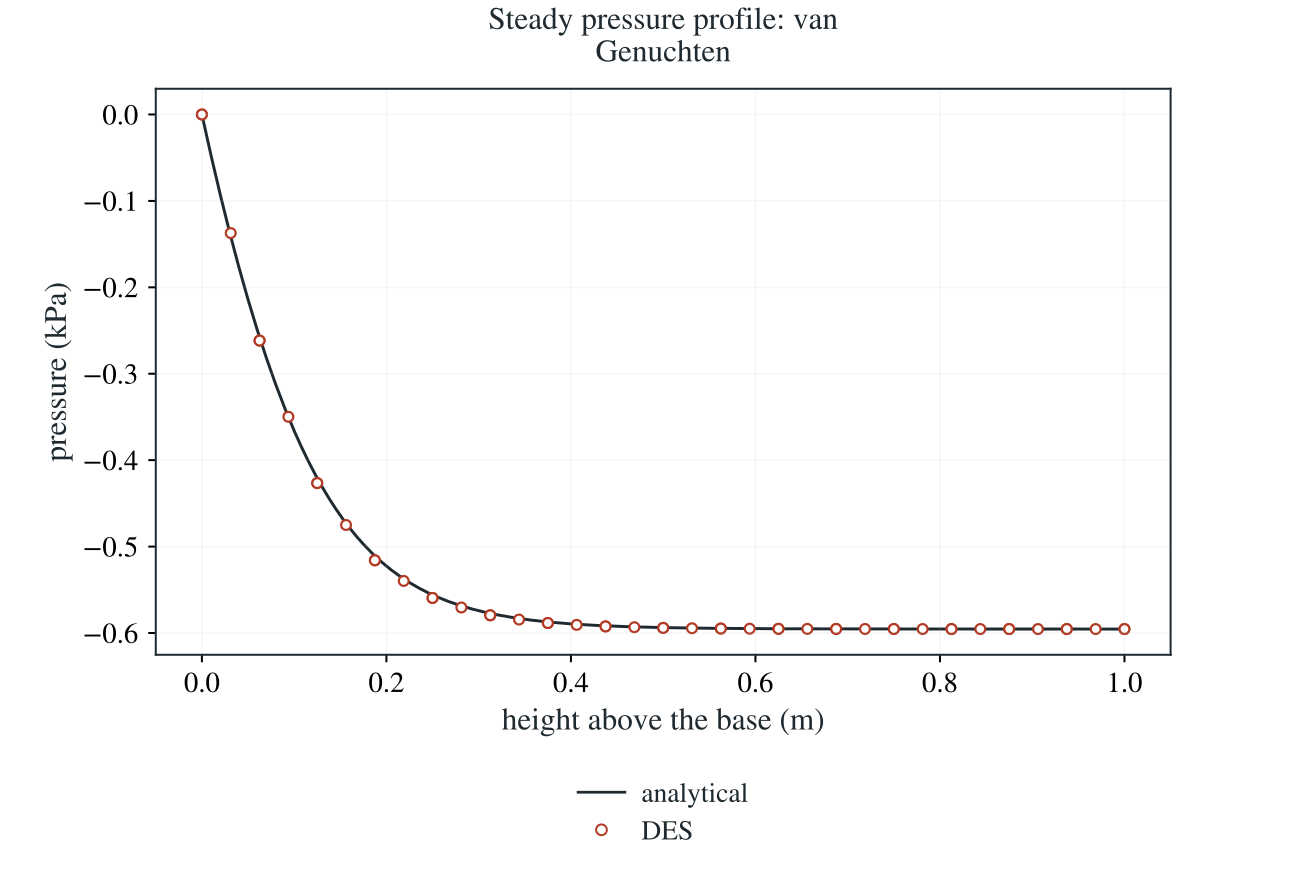
Steady pressure (kPa) against height above the water table at the end of the run: DES nodes (circles) and the steady-infiltration reference for the van Genuchten–Mualem law (line).
This checks the retention-dependent conductivity and the flux boundary. It does not test transient storage or coupled slope behaviour.
To reproduce the whole study behind this figure, from the DES source folder:
python3 tests/functional/hydromechanics/check_unsaturated_column.py dynearthsol2d OUT
The study’s full numbers: record.json.
Analytical reference
Elevation runs upward from the water-table base. is positive downward infiltration, saturated hydraulic conductivity, and . The integral is an implicit analytical relation, evaluated by high-accuracy integration of its equivalent first-order ODE.
Derivation
At steady state is constant. Darcy flow with upward includes both pressure and gravity. Rearranging and separating variables gives the integral shown above, starting from at .
For the pressure decreases with elevation toward the suction at which . The integral diverges at that limiting pressure. Storage and elastic compressibility do not enter this steady relation. The analytical relation is evaluated with an independent high-accuracy ODE solver; no DES output or fitting parameter is used.
The implicit relation is derived from steady Darcy flow; evaluated by DOP853 (rtol 10⁻¹², atol 10⁻⁹ Pa) in unsaturated_reference.py.
Validity and limits
Homogeneous, steady one-dimensional flow, constant gravity and prescribed flux. This is not a closed-form pressure profile. Storage drops out of the steady equation; the deliberately reduced fluid modulus shortens the run (a larger stable flow step) and does not test transient storage.