Drainage of a saturated column into the unsaturated state
A saturated sand column drains through its base: the top desaturates, pore pressure falls below zero and the column settles under the Bishop effective stress and its lighter weight, as in the Liakopoulos experiment. No closed form exists; an independent solver of the same continuum supplies the reference.
Largest nodal pressure error on the 0.0125 m mesh with 480 steps at 5, 20, 60 and 120 min: 0.14 / 0.02 / 0.02 / 0.01% of ; settlement 0.24 / 0.05 / 0.02 / 0.01%. With 960 steps: 0.07 / 0.02 / 0.01 / 0.01% and 0.12 / 0.03 / 0.01 / 0.01%.
| Dimension | 2D |
| Build | make ndims=2 from the poromechanics source (not yet merged; DynEarthSol #134) |
| Inputs | drainage.zip |
| Reproduce with | DynEarthSol 3774df0 |
Problem setup
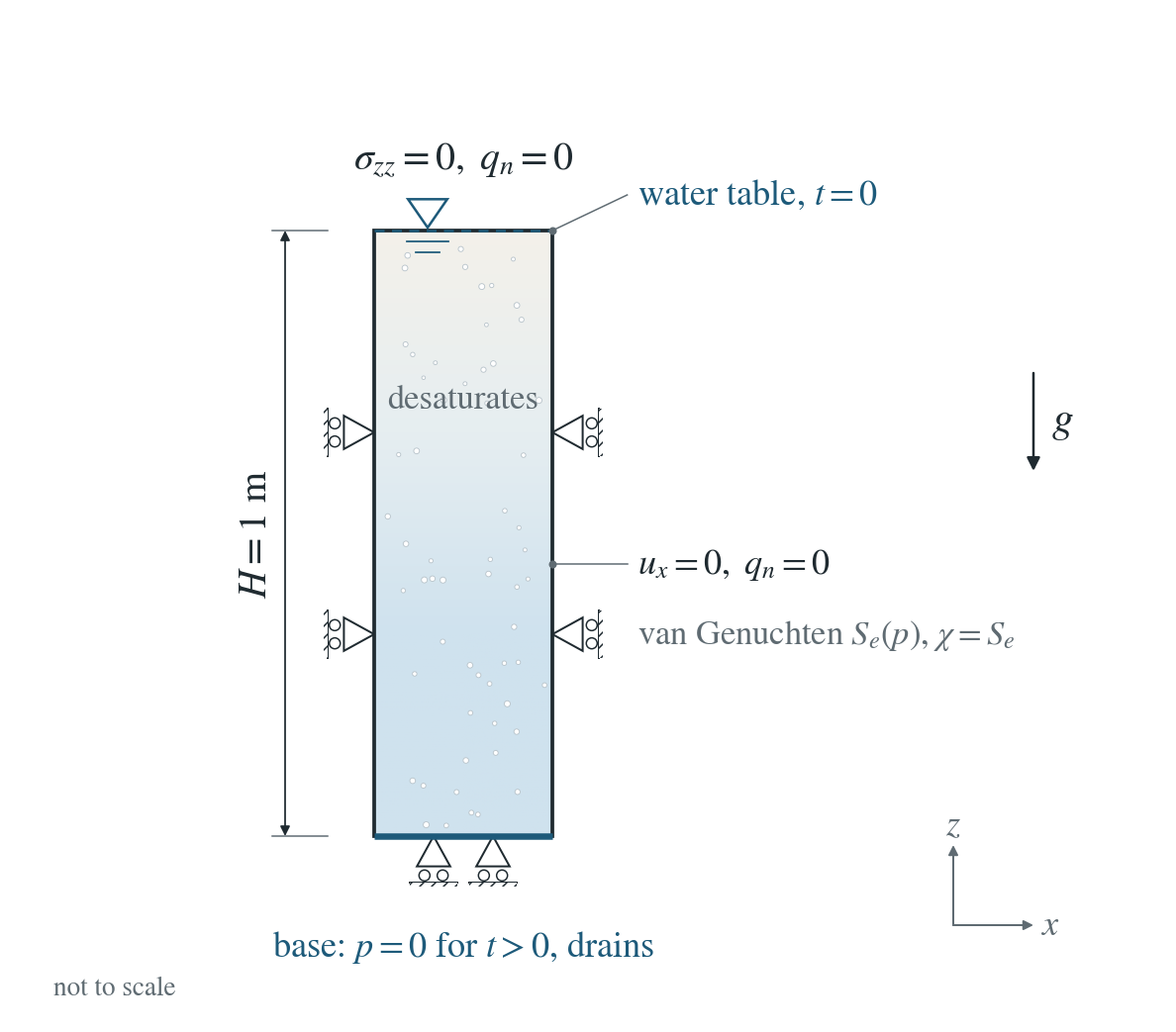
Column. A laterally confined sand column m high, saturated and hydrostatic with the water table at its top. Top sealed and traction-free; base fixed.
Drainage. At the base is opened to (a 1 ms ramp of the scheduled boundary pressure). Water drains out, the top desaturates and suction develops.
Material. After Liakopoulos: MPa, , , , ; van Genuchten , , , Mualem permeability; Bishop . Gravity and pressure feedback (two-way coupling) are on.
What is compared. Nodal pressure and the settlement of the top at 5, 20, 60 and 120 min against an independent solution of the same continuum.
Input and how to run
Every file this example needs is in drainage.zip. Run from that folder:
# Runs the 1 m column on the 0.0125 m mesh: 480 PT steps of 15 s, 2 h in all. The base pressure drops to 0 within the first millisecond and the column drains. DES writes drain.save.* every 20 steps (5 min).
dynearthsol2d input.cfg
Settings that define this example
| Setting | Value | What it does here |
|---|---|---|
control.has_PT | true | PT solver: mechanical equilibrium within each step, with two-way pressure feedback |
control.gravity | 9.81 | gravity drives the drainage and sets the hydrostatic start |
control.fixed_dt | 15.0 | 15 s steps: 480 steps over 2 h |
sim.output_step_interval | 20 | a frame every 20 steps (5 min), which includes the compared times 5, 20, 60 and 120 min |
bc.hbc_z0 | 2 | type 2: the base pressure is prescribed by bc.hbc_pressure and the schedule; the top and sides are sealed |
bc.hbc_pressure | [0,0,0,0,9810.0,0] | base pressure 9810 Pa, the hydrostatic value with the water table at the top (ic.water_table_z = 0, the default) |
bc.hbc_schedule_time_in_yr | [0, 3.168876453507857e-11] yr = [0, 0.001] s | schedule times 0 and 1 ms, in years |
bc.hbc_schedule_ratio | [1, 0] | multipliers 1 and 0: the base pressure ramps to 0 over the first millisecond, opening the base |
ic.has_body_force_adjustment | true | brings the column into mechanical equilibrium under gravity before the run |
mat.bulk_modulus | [2166666.666666667] | K = 2.17e6 Pa, from E = 1.3 MPa and ν = 0.4 |
mat.shear_modulus | [464285.7142857143] | G = 4.64e5 Pa, from E = 1.3 MPa and ν = 0.4 |
mat.porosity | [0.2975] | φ = 0.2975, the Liakopoulos sand |
mat.hydraulic_perm | [4.5e-13] | intrinsic permeability 4.5e-13 m² |
mat.retention_model | [1] | 1: van Genuchten–Mualem, with retention_alpha 1/3000 1/Pa, retention_n 1.8 and residual_saturation 0.1; Bishop χ = S_e |
input.cfg holds all 59 settings that differ from DES’s defaults; dynearthsol2d -h lists every option with its default.
Output
See Running the examples for output files, the Python reader and ParaView conversion.
| Field | What to look at |
|---|---|
pore pressure | pressure profiles at 5, 20, 60 and 120 min, compared with the reference |
strain | vertical element strain; its change since frame 0, summed up the column, gives the settlement of the top |
coordinate | node heights |
connectivity | assigns element strains to the layers of the column |
Result: DES and the reference
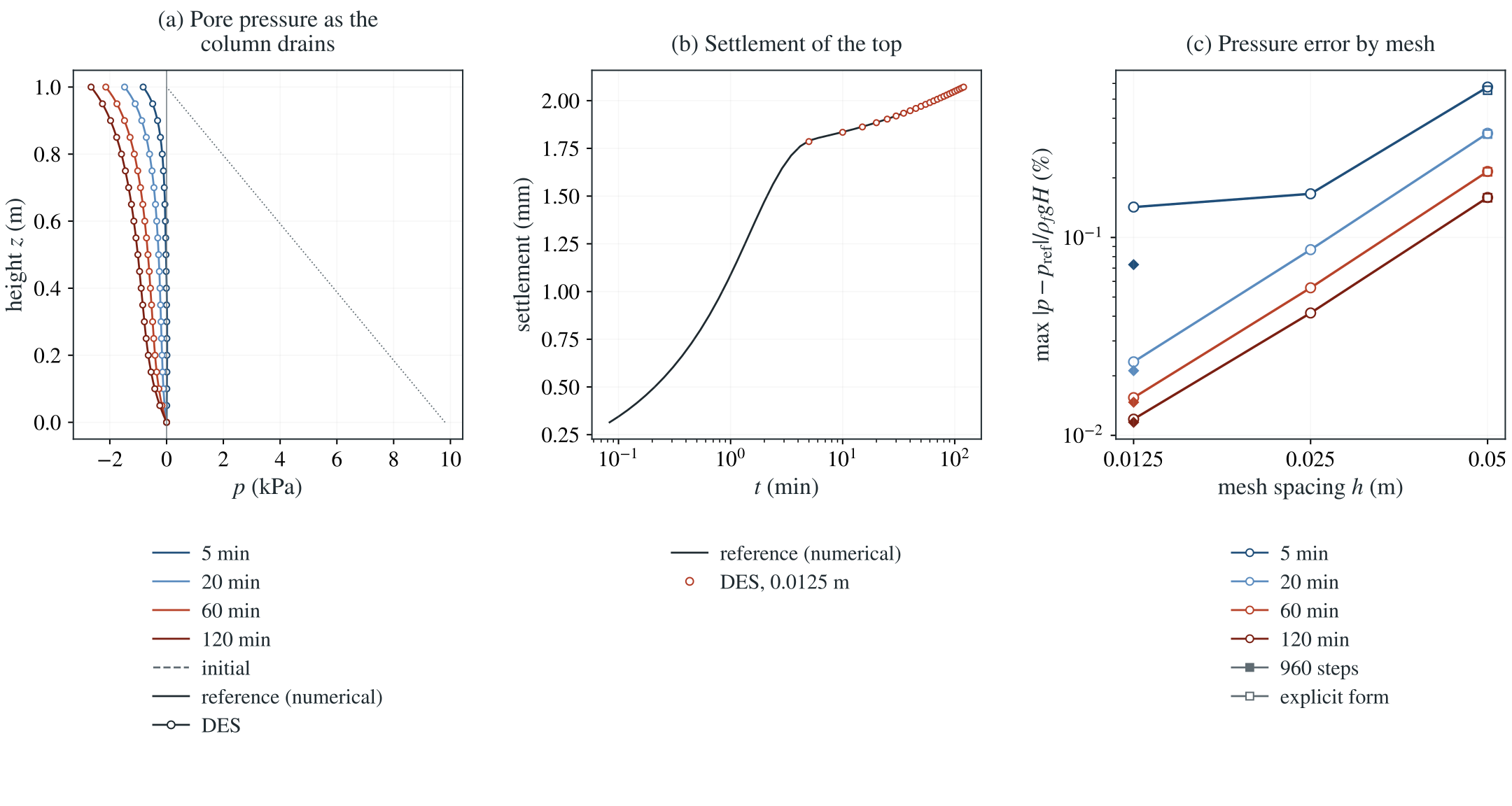
(a) Pore pressure (kPa) against height at 5, 20, 60 and 120 min: DES nodes on one side of the column (circles) and the numerical reference (lines); the dotted line is the initial hydrostatic profile. (b) Settlement of the top against time on a log scale: DES at each saved frame (circles) and the reference (line). (c) Maximum pressure error relative to ρ_f g H against mesh spacing at the four times: circles for 480 steps, diamonds for 960 steps on the finest mesh, open squares for the explicit form.
This checks Richards flow and the Bishop coupling together during drainage: desaturation, suction, the effective-stress change and the lighter weight of the drying column.
To reproduce the whole study behind this figure, from the DES source folder:
python3 benchmarks/poromechanics/drainage_reference.py
python3 tests/functional/hydromechanics/check_unsaturated_drainage.py dynearthsol2d OUT --spacings 0.05 0.025 0.0125
python3 tests/functional/hydromechanics/check_unsaturated_drainage.py dynearthsol2d OUT-explicit --spacings 0.05 --explicit
python3 tests/functional/hydromechanics/check_unsaturated_drainage.py dynearthsol2d OUT-steps960 --spacings 0.0125 --steps 960
The study’s full numbers: record.json.
Reference solution (numerical)
is the fluid storage including ; the vertical strain, the total vertical stress, which changes only by the weight of the water that leaves the column above. is the Mualem relative permeability.
Derivation
Uniaxial strain makes the vertical effective-stress change equal to the constrained modulus times the strain. The Bishop stress adds , and the total stress follows the weight, so drying above a point unloads it: the storage becomes nonlocal.
drainage_reference.py integrates this system with vertex-centred finite volumes, the dense coupled storage matrix and an implicit BDF method. Grid differences fall at second order (5.2 to 1.3 Pa at 300 s on 100 and 200 cells, of a 9.8 kPa scale); the comparison uses 200 cells.
Liakopoulos (1965) experiment as benchmarked by Schrefler and Zhan (1993), Water Resources Research 29(1), 155–167; reference computed independently in drainage_reference.py.
Validity and limits
No closed form: the reference is numerical. Uniaxial strain, small strain, constant porosity, no hysteresis. The base opens instantly, so the first minutes are limited by the step.