Weak zones
DES3D supports several ways to define fault-like weak zones that focus
deformation in a model, selected with weakzone_option in the [ic]
section:
weakzone_option | What it creates |
|---|---|
0 | No weak zone |
1 | A single planar weak zone: azimuth, inclination, half-width, depth range and center location |
2 | An ellipsoidal weak zone: center location and semi-axes |
3 | A Gaussian-distribution point weak zone: center location and standard deviation |
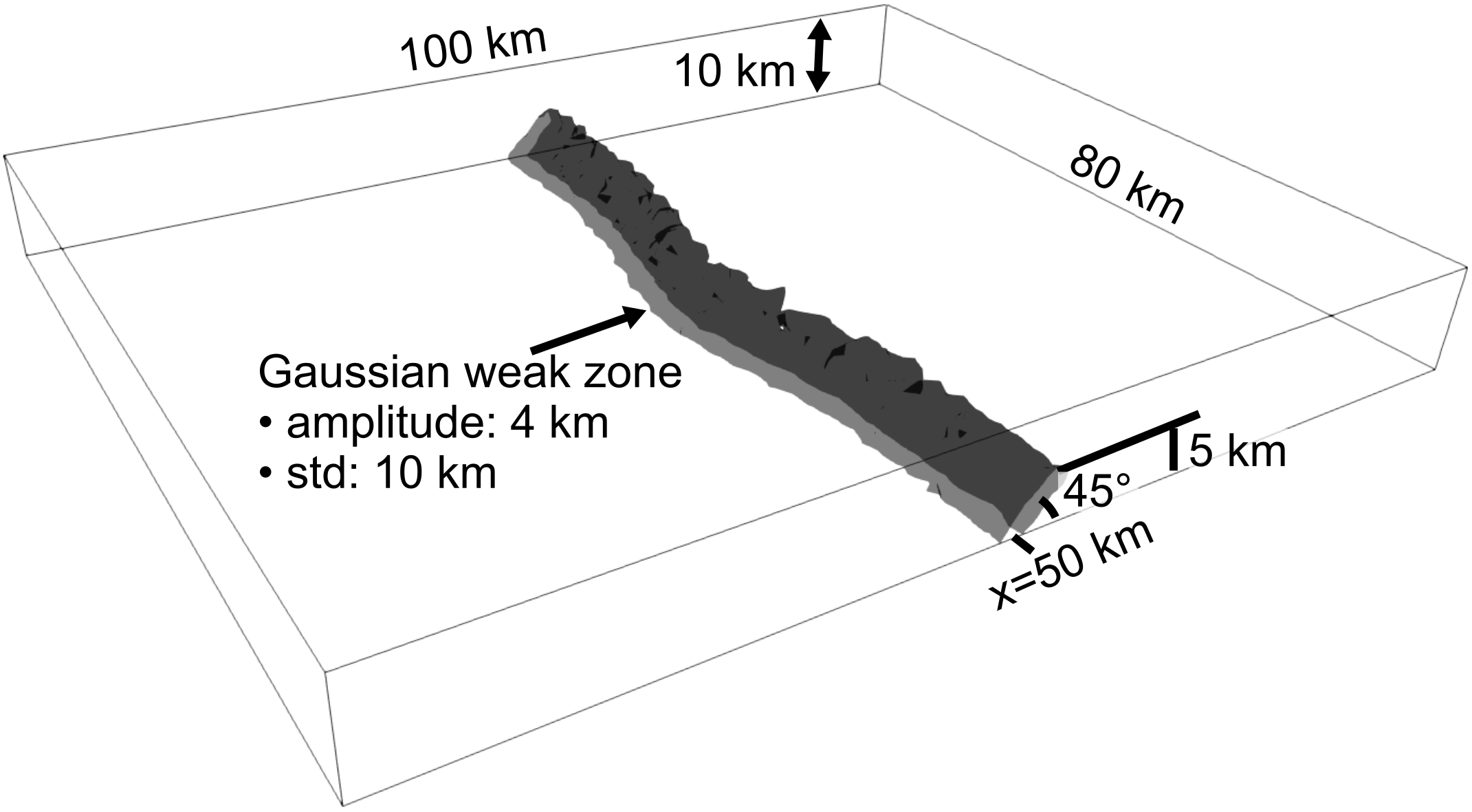
4 | A single planar fault whose map-view position bulges along strike following a Gaussian — see below |
5 | Multiple general planar segments — see below |
weakzone_azimuth is measured relative to the model's +y axis, not
geographic north, and weakzone_inclination relative to the horizontal
plane — both in degrees.
Multi-segment weak zones (weakzone_option = 5)
For models that require more than one pre-existing fault (e.g.,
conjugate normal faults or a step-over fault system), use
weakzone_option = 5. This option accepts any number of planar fault
segments, each with its own center, orientation, half-width and spatial
bounds; a point belongs to the weak zone if any segment contains it.
Each segment uses a General_planar_zone formulation with a proper
unit-normal, avoiding the tan(azimuth) numerical singularity of the
single-fault Planar_zone (option 1).
Configuration
Every weakzone_segments_* parameter is an array with one entry per
segment, [v0, v1, ...], of length weakzone_num_segments:
[ic]
weakzone_option      = 5
weakzone_plstrain    = 0.5   # plastic strain assigned inside any segment
weakzone_num_segments = 2    # number of fault segments

# Segment centers (normalized 0-1, in units of mesh.xlength/ylength/zlength)
weakzone_segments_xcenter = [0.35, 0.65]
weakzone_segments_ycenter = [0.5,  0.5]    # 3D only
weakzone_segments_zcenter = [0.5,  0.5]

# Opposite dip directions, same dip angle
weakzone_segments_azimuth     = [0,   180]  # degrees, relative to +y axis
weakzone_segments_inclination = [60,  60]   # degrees, relative to horizontal
weakzone_segments_halfwidth   = [1.5, 1.5]  # in units of mesh.resolution

# Bounding box per segment (normalized 0-1)
weakzone_segments_x_min     = [0.0, 0.5]
weakzone_segments_x_max     = [0.5, 1.0]
weakzone_segments_y_min     = [0.0, 0.0]    # 3D only
weakzone_segments_y_max     = [1.0, 1.0]    # 3D only
weakzone_segments_depth_min = [0.0, 0.0]
weakzone_segments_depth_max = [1.0, 1.0]

See examples/conjugate-faults-3d.cfg for this two-segment conjugate
normal-fault setup in full.
weakzone_num_segments can be set to any positive integer; every
weakzone_segments_* array above must then have exactly that many
entries.
Gaussian along-strike shift (weakzone_option = 4)
weakzone_option = 4 places a single planar fault — geometrically the
same as option 1 (azimuth, inclination, half-width, depth range, center)
— but shifts its map-view x-position along strike by a Gaussian bulge:
where is weakzone_gaussian_amplitude and is
weakzone_standard_deviation. This is useful for localizing the initial
failure to the center of the model domain while tapering to a straight
fault toward the lateral edges.
[ic]
weakzone_option   = 4
weakzone_azimuth      = 0.0     # relative to +y axis (degrees)
weakzone_inclination  = -45.0   # relative to horizontal plane (degrees)
weakzone_halfwidth    = 1.2     # in units of mesh.resolution
weakzone_depth_min    = 0.5
weakzone_depth_max    = 1.0
weakzone_xcenter      = 0.5
weakzone_ycenter      = 0.5     # 3D only
weakzone_zcenter      = 1.0
weakzone_y_min        = 0.0     # 3D only
weakzone_y_max        = 1.0     # 3D only
weakzone_plstrain     = 0.5

weakzone_gaussian_amplitude = -4000  # x-shift at peak (m)
weakzone_standard_deviation = 1e4    # sigma along y (m)
See gospl_driver/examples/gaussian-weakzone-3d-with-gospl.cfg
for this exact configuration, combined with GoSPL surface-process
coupling — see Coupling with GoSPL.