Cryer consolidation of a sphere
A drained poroelastic sphere is suddenly loaded on its surface. The shell drains and contracts first, squeezing the core, so the centre pressure rises before it decays.
Largest pressure error after : 0.62% of , and 2.12% including the first-step lag. Sampled centre peak: DES , analytical .
| Dimension | 3D |
| Build | make ndims=3 from the poromechanics source (not yet merged; DynEarthSol #134) |
| Inputs | cryer.zip |
| Reproduce with | DynEarthSol 3774df0 |
Problem setup
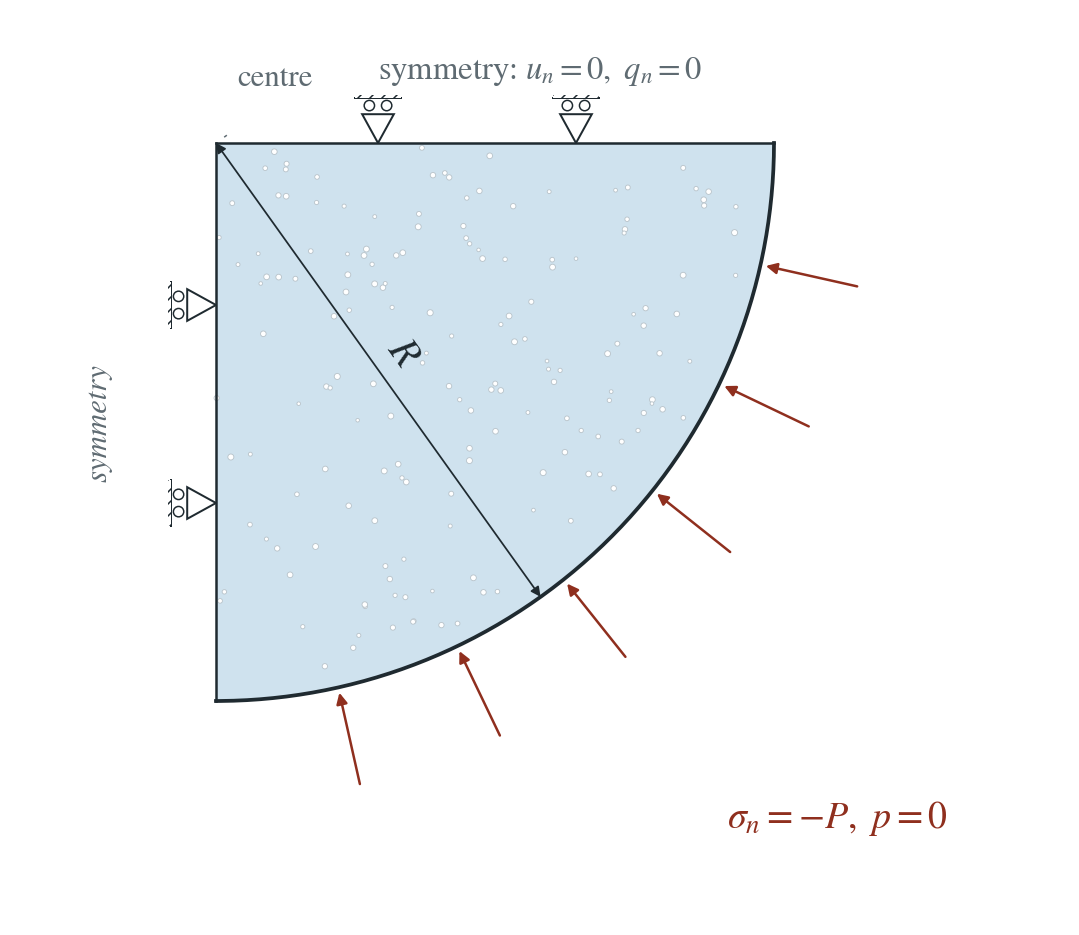
Load and drainage. A poroelastic sphere of radius receives a uniform compressive normal stress at on its drained surface (). DES applies it as a normal stress on the curved facets.
Mesh and symmetry. One octant is meshed: the three flat faces are symmetry planes (normal motion fixed, sealed), the curved surface is subdivided on the sphere.
What is compared. Pressure at every node, and especially at the centre, against the series solution. The centre pressure first rises above its undrained value (Mandel–Cryer effect).
Input and how to run
Every file this example needs is in cryer.zip. Run from that folder:
# Meshes the sphere octant from octant.poly (shipped in the same folder) at 0.07 m, runs 800 steps over 0.5 R^2/c (20.9 s) and writes cryer.save.* every 20 steps, with a checkpoint every 10th frame. This is a 3D run and takes much longer than the 2D examples.
dynearthsol3d input.cfg
Settings that define this example
| Setting | Value | What it does here |
|---|---|---|
mesh.meshing_option | 90 | 90: the domain boundary is read from a .poly file instead of a box |
mesh.poly_filename | octant.poly | octant.poly: one octant of a unit sphere; the curved surface carries the top (z1) boundary flag, the flat faces x = 0, y = 0 and z = 0 the x0, y0 and z0 flags |
mesh.resolution | 0.07 | target element size used when meshing the octant |
control.has_hydraulic_diffusion | true | turns on Darcy flow, so water drains out through the curved surface |
control.has_PT | true | solves the mechanics to equilibrium at every step with PT, so the sudden surface load is carried without elastic waves |
control.gravity | 0 | no gravity: only the surface load creates pressure |
control.fixed_dt | 0.026153118474050982 | physical time step, 1/800 of 0.5 R^2/c |
sim.max_steps | 800 | 800 steps; this, not max_time_in_yr, ends the run |
bc.vbc_y0 | 1 | fixes normal motion on the symmetry plane y = 0 (x = 0 is fixed by the default vbc_x0) |
bc.vbc_z0 | 1 | fixes normal motion on the symmetry plane z = 0, which carries the z0 flag in octant.poly |
bc.hbc_z1 | 2 | type 2: the curved surface is drained, pore pressure held at its hbc_pressure entry (0 Pa); the symmetry planes stay sealed |
bc.stress_bc_z1 | 4 | type 4: a normal stress on facets of any orientation, here the curved sphere surface |
bc.stress_val_z1 | -100000.0 | the surface pressure; negative is compression (100 kPa) |
mat.hydraulic_perm | [1.03e-12] | intrinsic permeability; with storage and stiffness it sets the consolidation coefficient c |
input.cfg holds all 41 settings that differ from DES’s defaults; dynearthsol3d -h lists every option with its default.
Output
See Running the examples for output files, the Python reader and ParaView conversion.
| Field | What to look at |
|---|---|
pore pressure | nodal pressure; the node nearest the centre gives panel (a), all nodes binned by radius give the profiles in panel (b), and the largest nodal error gives panel (c) |
Result: DES and the analytical solution
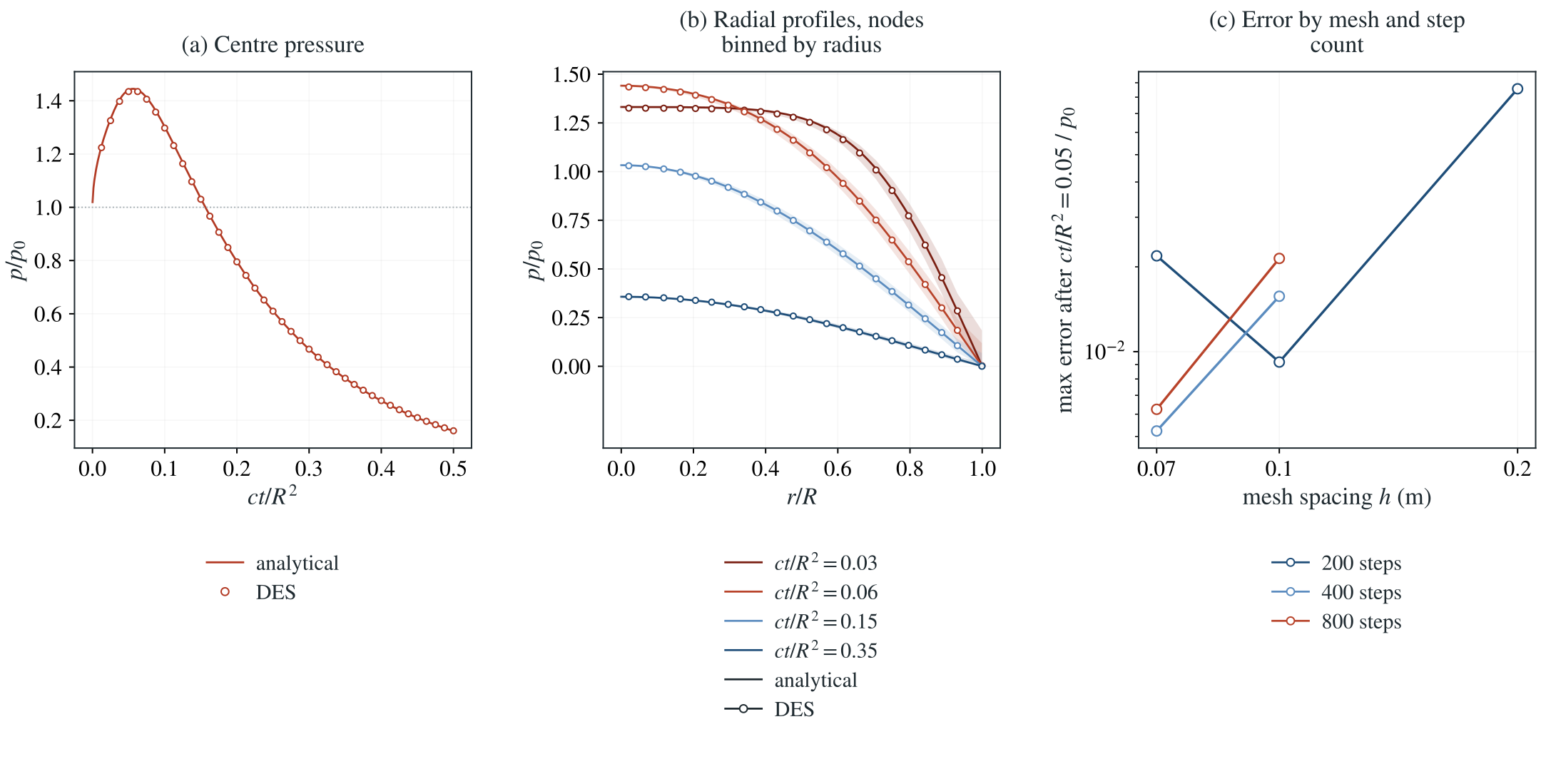
(a) Pressure at the centre of the sphere, scaled by the undrained pressure p0, against ct/R^2: the line is the series solution, symbols are DES; the dotted line marks p/p0 = 1, which the centre pressure first exceeds. (b) Radial pressure profiles at four times: lines are the series solution, symbols are the mean of the DES nodes in each radius bin and the shaded band their spread. (c) Largest pressure error after ct/R^2 = 0.05 against mesh spacing, one line per number of time steps.
This checks 3D two-way coupling under a sudden load, the Mandel–Cryer pressure and the normal-stress load on a curved surface. It does not remove the one-step lag of the sequential coupling in the earliest frames, which falls with the time step.
To reproduce the whole study behind this figure, from the DES source folder:
python3 tests/functional/hydromechanics/check_cryer.py dynearthsol3d OUT/cryer-h --spacings 0.2 0.1 0.07 --steps 200
python3 tests/functional/hydromechanics/check_cryer.py dynearthsol3d OUT/cryer-t400 --spacings 0.1 --steps 400
python3 tests/functional/hydromechanics/check_cryer.py dynearthsol3d OUT/cryer-h0.1-t800 --spacings 0.1 --steps 800
python3 tests/functional/hydromechanics/check_cryer.py dynearthsol3d OUT/cryer-h0.07-t400 --spacings 0.07 --steps 400
python3 tests/functional/hydromechanics/check_cryer.py dynearthsol3d OUT/cryer-h0.07-t800 --spacings 0.07 --steps 800
The study’s full numbers: record.json.
Analytical reference
Here , are drained moduli, the Biot coefficient, , the intrinsic permeability and the viscosity. The runs use m, Pa and the material of the Mandel page, so , s and .
Derivation
Spherical symmetry makes the displacement irrotational, so . The surface traction fixes through the volume-average pressure , and the fluid balance becomes a diffusion equation forced by .
With , and , the Laplace transform is closed. Its poles give the roots and their residues the weights . The series is checked against a numerical (Stehfest) inversion of the transform.
Cryer (1963); Detournay and Cheng (1993). Derived and evaluated in cryer_reference.py with the same material values; the series agrees with a Stehfest inversion to 1.3e-4.
Validity and limits
Small strain, linear isotropic poroelasticity with constant properties; the curved surface is a faceted approximation of the sphere. DES couples pressure and mechanics sequentially, so the earliest frames carry the one-step lag of that split. No gravity.