Mandel consolidation under a rigid plate
Rigid frictionless plates squeeze a drained poroelastic strip. The edges drain first, load shifts to the undrained core, and the centre pressure rises before it decays.
Largest pressure error: 0.83% of , over all nodes and times; largest relative settlement error: 0.11%. Sampled centre peak: DES , analytical .
| Dimension | 2D |
| Build | make ndims=2 from the poromechanics source (not yet merged; DynEarthSol #134) |
| Inputs | mandel.zip |
| Reproduce with | DynEarthSol 3774df0 |
Problem setup
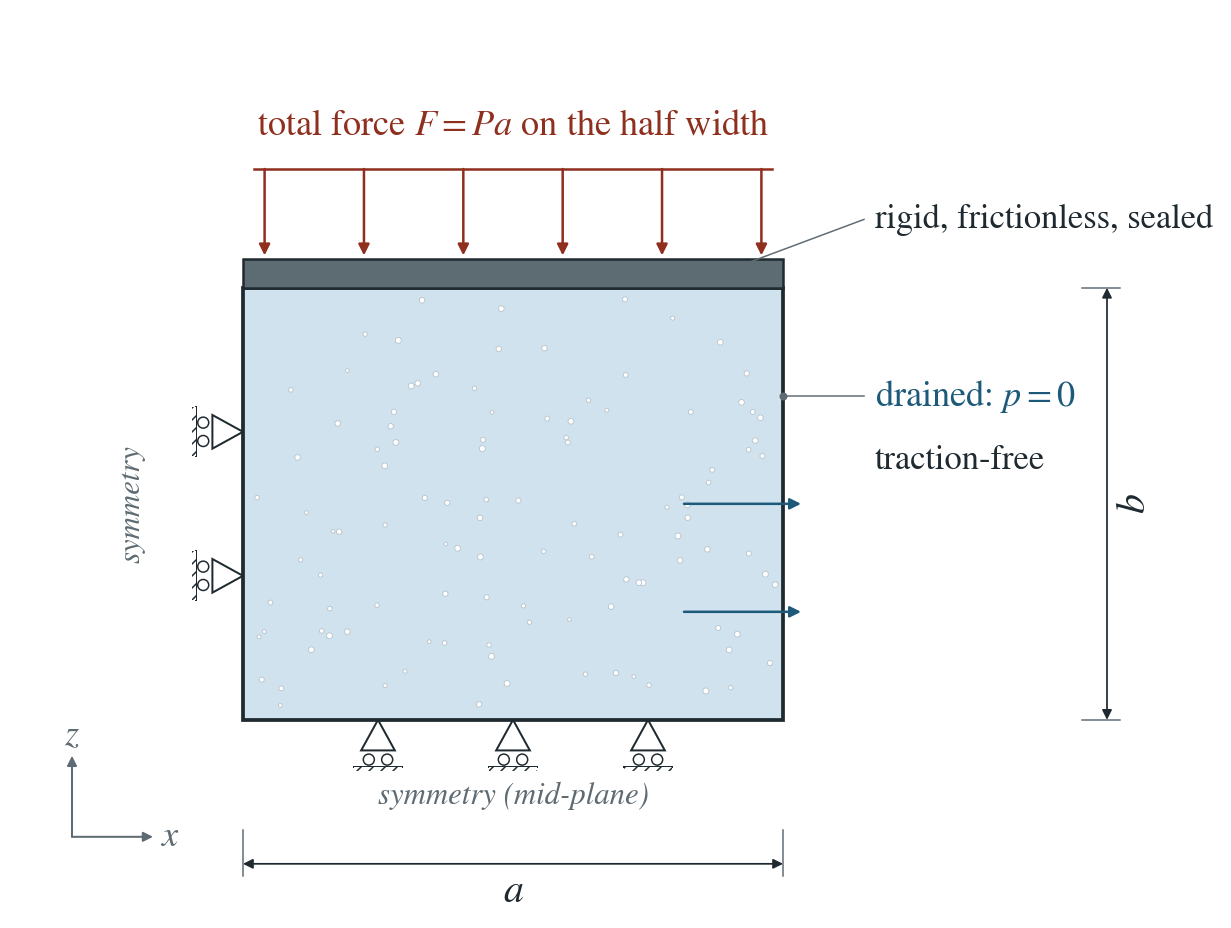
Load and plates. Rigid, frictionless, impermeable plates squeeze the strip with a total force per unit length, applied at . DES models the top plate with a rigid platen: every top node shares one vertical velocity and slides freely.
Drainage and symmetry. The faces are drained () and traction-free. One quarter is meshed: symmetry at and at the mid-plane, both sealed.
What is compared. Pressure at every node and the uniform plate settlement, against the series solution. At the centre the pressure first rises above its undrained value : the Mandel–Cryer effect.
Input and how to run
Every file this example needs is in mandel.zip. Run from that folder:
# Runs the quarter strip (a = b = 1 m) on a 0.05 m mesh for 800 steps over one consolidation time a^2/c (41.8 s) and writes mandel.save.* every 20 steps, with a checkpoint every 10th frame.
dynearthsol2d input.cfg
Settings that define this example
| Setting | Value | What it does here |
|---|---|---|
control.has_hydraulic_diffusion | true | turns on Darcy flow, so water drains out through the side x = a |
control.has_PT | true | solves the mechanics to equilibrium at every step with PT, so the sudden plate load is carried without elastic waves |
control.gravity | 0 | no gravity: only the plate load creates pressure |
control.fixed_dt | 0.05230623694810197 | physical time step, 1/800 of the consolidation time a^2/c |
sim.max_steps | 800 | 800 steps; this, not max_time_in_yr, ends the run |
sim.output_step_interval | 20 | writes a frame every 20 steps |
bc.vbc_x1 | 0 | type 0: the drained side x = a is free to move (traction-free) |
bc.vbc_z0 | 1 | fixes vertical motion on the bottom edge, the mid-plane of the strip (symmetry) |
bc.vbc_z1 | 8 | type 8: rigid frictionless platen; all top nodes share one vertical velocity and slide freely sideways |
bc.stress_bc_z1 | 3 | type 3: the platen is pushed by a vertical traction |
bc.stress_val_z1 | -100000.0 | the plate pressure; negative is compression (100 kPa, total force F = Pa) |
bc.hbc_x1 | 2 | type 2: the side x = a is drained, pore pressure held at its hbc_pressure entry (0 Pa); the other sides stay sealed |
mat.bulk_modulus | [10000000.0] | drained bulk modulus K (with G it sets the Poisson ratio and p0) |
mat.hydraulic_perm | [1.03e-12] | intrinsic permeability; with storage and stiffness it sets the consolidation coefficient c |
input.cfg holds all 46 settings that differ from DES’s defaults; dynearthsol2d -h lists every option with its default.
Output
See Running the examples for output files, the Python reader and ParaView conversion.
| Field | What to look at |
|---|---|
pore pressure | nodal pressure; centre and x = a/2 histories in panel (a), profiles across the strip in panel (b), and the error at every node in panel (c) |
strain | element strain; the vertical component averaged over the quarter gives the plate settlement, whose error is in panel (c) |
velocity | nodal velocity; the vertical velocity of the top row should be the same at every node under the rigid platen |
Result: DES and the analytical solution
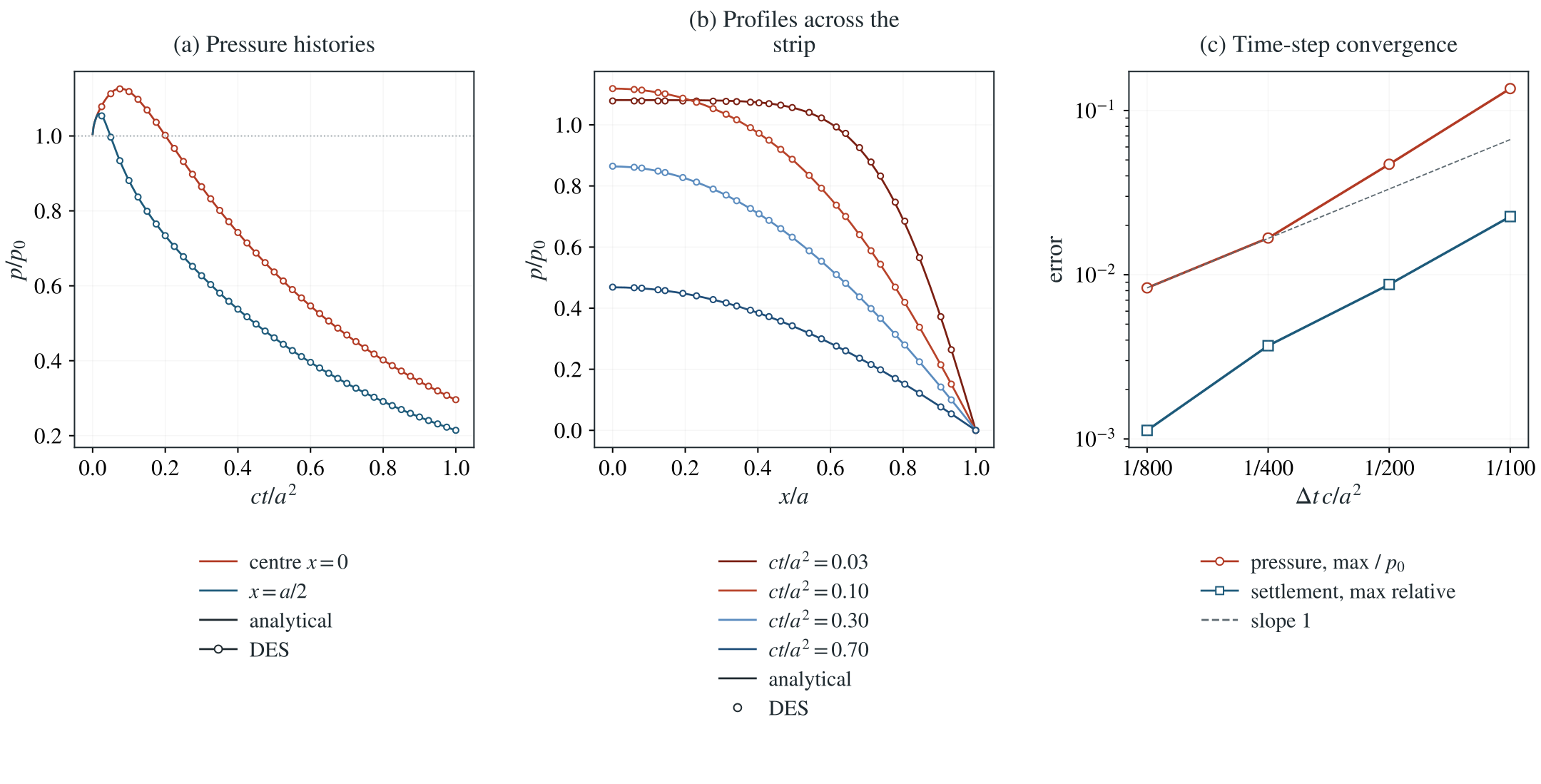
(a) Pressure history at the centre x = 0 and at x = a/2, scaled by the undrained pressure p0, against ct/a^2: lines are the series solution, symbols are DES; the dotted line marks p/p0 = 1, which the centre pressure first exceeds. (b) Pressure profiles across the strip at four times. (c) Largest pressure error (over all nodes and times, divided by p0) and largest relative settlement error against the time step, on log axes, with a slope-1 guide.
This checks two-way poroelastic coupling under a sudden load, the non-monotonic Mandel–Cryer pressure and the rigid-platen boundary. It does not test large strain or plasticity.
To reproduce the whole study behind this figure, from the DES source folder:
python3 tests/functional/hydromechanics/check_mandel.py dynearthsol2d OUT/mandel-h --spacings 0.1 0.05 0.025 --steps 200
python3 tests/functional/hydromechanics/check_mandel.py dynearthsol2d OUT/mandel-t100 --spacings 0.05 --steps 100
python3 tests/functional/hydromechanics/check_mandel.py dynearthsol2d OUT/mandel-t400 --spacings 0.05 --steps 400
python3 tests/functional/hydromechanics/check_mandel.py dynearthsol2d OUT/mandel-t800 --spacings 0.05 --steps 800
The study’s full numbers: record.json.
Analytical reference
Here and are the half width and half height, and the drained and undrained Poisson ratios, the shear modulus, the intrinsic permeability and the viscosity. The undrained pressure is . The runs use m, with Pa, Pa, , , GPa, GPa and , so and s.
Derivation
A rigid frictionless plate makes uniform; at the drained faces and equilibrium make everywhere, so the problem is one-dimensional in . The fluid balance then contains the unknown plate strain rate, and the plate force fixes it through the integral of over the width.
Separation of variables with the drained condition and this integral constraint gives the roots and the series above; the initial undrained state fixes the coefficients. The same series gives the plate settlement.
Mandel (1953); Abousleiman et al. (1996), Mandel’s problem revisited. Evaluated independently in mandel_reference.py with the same material values.
Validity and limits
Plane strain, small strain, linear isotropic poroelasticity with constant properties; ideal rigid frictionless plates. DES couples pressure and mechanics sequentially; the early-time error is the one-step lag of that split and falls with the time step. No gravity.