Terzaghi consolidation of a column
A sudden load compresses a saturated column. Water drains through the top, the pressure falls and the column settles.
Largest pressure error: 0.011% of the applied load; largest settlement error: 0.007% of the final drained settlement.
| Dimension | 2D |
| Build | make ndims=2 from the poromechanics source (not yet merged; DynEarthSol #134) |
| Inputs | terzaghi.zip |
| Reproduce with | DynEarthSol 3774df0 |
Problem setup
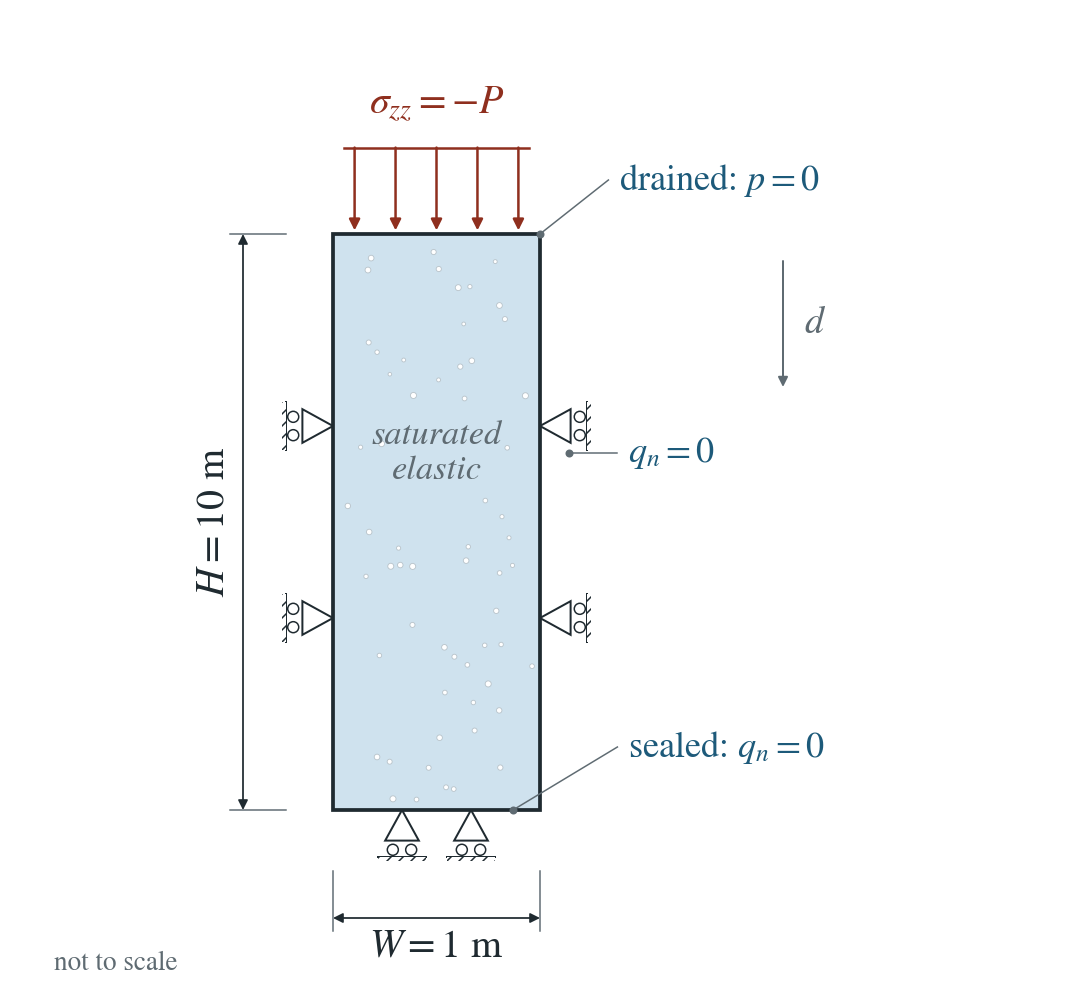
Load and drainage. At a compression kPa is applied; the top is drained, .
Constraints. Sides: zero normal displacement and zero normal water flux. Base: vertical displacement fixed, water flux zero.
Initial state and comparison. Initially unloaded. The reference starts just after the instantaneous undrained load. Compare pressure and downward top settlement.
Input and how to run
Every file this example needs is in terzaghi.zip. Run from that folder:
# Runs the 10 m column on a 0.25 m mesh for 33600 steps of 0.25 s (8400 s, about 99% consolidated) and writes terzaghi.save.000000 to terzaghi.save.000007, one frame every 1200 s; frame 0 is the state before the load.
dynearthsol2d input.cfg
Settings that define this example
| Setting | Value | What it does here |
|---|---|---|
control.has_hydraulic_diffusion | true | turns on Darcy flow, so the excess pressure drains out through the top |
control.has_PT | true | solves the mechanics to equilibrium at every step with PT, so the sudden load is carried without elastic waves |
control.has_moving_mesh | false | keeps the mesh fixed (small strain); settlement is computed from the vertical strain, not from moved nodes |
control.gravity | 0 | no gravity: only the applied load creates pressure |
control.fixed_dt | 0.25 | physical time step |
sim.max_steps | 33600 | number of steps; with fixed_dt it sets the 8400 s simulated |
sim.output_step_interval | 4800 | writes a frame every 4800 steps (1200 s) |
bc.hbc_z1 | 1 | type 1: the top is drained, pore pressure held at its initial value (0) |
bc.stress_bc_z1 | 3 | type 3: a vertical traction is applied on the top |
bc.stress_val_z1 | -1e5 | the top load; negative is compression (100 kPa) |
bc.vbc_z0 | 1 | fixes vertical motion of the base |
mat.bulk_modulus | [1e7] | drained bulk modulus K of the skeleton |
mat.shear_modulus | [1e7] | shear modulus G; with K it sets the constrained modulus K + 4G/3 |
mat.hydraulic_perm | [1.03e-12] | intrinsic permeability; with viscosity and storage it sets the consolidation coefficient c_v |
input.cfg holds all 39 settings that differ from DES’s defaults; dynearthsol2d -h lists every option with its default.
Output
See Running the examples for output files, the Python reader and ParaView conversion.
| Field | What to look at |
|---|---|
pore pressure | nodal pressure; profiles against depth below the drained top are compared with the series in panel (a) |
strain | element strain; the vertical component integrated over the column gives the top settlement in panel (b) |
Result: DES and the analytical solution
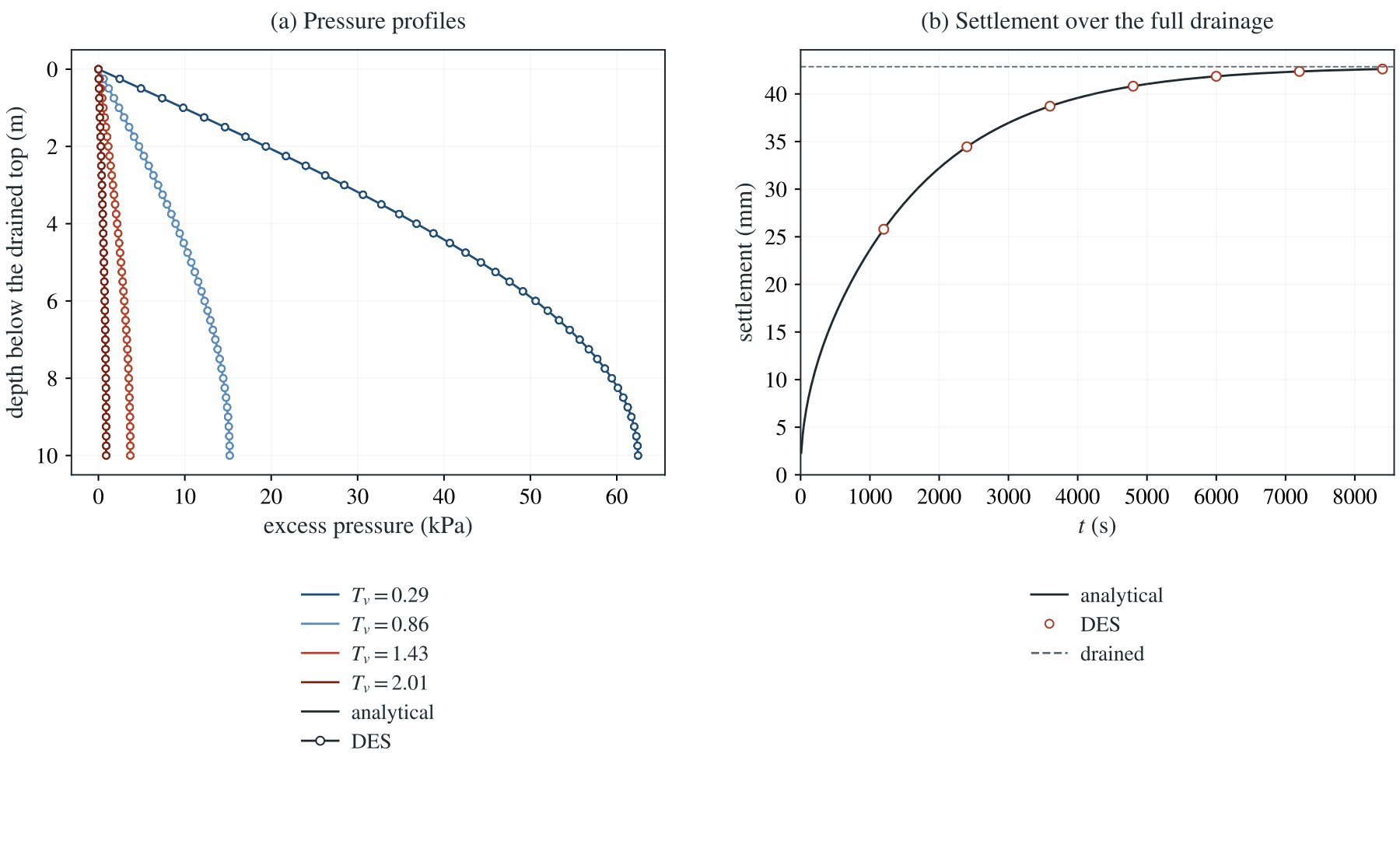
(a) Pressure profiles against depth below the drained top at several dimensionless times T_v: lines are the series solution, symbols are DES. (b) Settlement of the top against time over the full drainage: the line is the series solution, symbols are DES, and the dashed line is the final drained settlement.
This checks fluid storage and elastic coupling together, through both pressure and settlement. It does not test a sudden load with GVS or large strain.
Partial unloading and material regimes
To reproduce the whole study behind this figure, from the DES source folder:
python3 benchmarks/poromechanics/consolidation_refinement.py --output OUT/history-2d --dimensions 2 --spacings 1 0.5 0.25 --timesteps 1 0.5 0.25 --spatial-dt 0.25 --temporal-spacing 0.5 --duration 8400 --sample-interval 1200 --timeout 30000
python3 benchmarks/poromechanics/consolidation_refinement.py --output OUT/sanity-3d --dimensions 3 --spacings 1 0.5 0.25 --timesteps 1 0.5 0.25 --spatial-dt 0.25 --temporal-spacing 1 --duration 8400 --sample-interval 1200 --timeout 30000
The study’s full numbers: record.json.
Analytical reference
Depth runs downward from the drained top () to the base (). is positive compression and positive downward settlement; is intrinsic permeability, viscosity, porosity, and the Biot coefficient. , , and are the drained bulk, shear, fluid and grain moduli.
Derivation
Equilibrium makes the total vertical stress uniform: . With tension-positive strain, . Substitute this strain into the fluid content .
Zero fluid-content change during the instantaneous load gives . Thereafter and . The mixed-boundary eigenfunctions are ; expanding the uniform initial pressure gives the coefficients above. Integrating compressive strain gives the settlement, including its instantaneous undrained part.
The series and settlement follow directly from the stated one-dimensional Biot initial/boundary problem; evaluated in terzaghi_reference.py.
Coupled GVS and PT in 3D
A separate 1 m × 1 m × 10 m confined column receives a sudden 100 kPa
traction, with MPa, MPa, zero gravity, a fixed mesh, sealed
sides/base and a drained top. Pressure and settlement use the same
analytical series at each saved frame's actual time. PT1 uses a 1 s
physical interval; shear-ceiling GVS uses scaling , an initial
velocity scale of m/s, fixed_dt=0 and dt_fraction=0.5.
| Method | (m) | Late pressure / load error | Late settlement / drained settlement | Final free-node force / total load |
|---|---|---|---|---|
| PT1 | 1 | 0.4915% | 0.1679% | |
| PT1 | 0.5 | 0.1706% | 0.1011% | |
| GVS shear | 1 | 0.8916% | 0.1551% | |
| GVS shear | 0.5 | 0.2196% | 0.03967% |
Late means 200–400 s; the drainage time is 2,933.74 s. Over the entire saved 40–400 s window, fine-grid pressure errors are 0.8685% (GVS) and 0.8417% (PT1). Halving the mesh also changes the automatic GVS step, so this is combined mesh/step evidence. The coarse eleven-case matrix covers PT0/PT1, ordinary explicit and both GVS ceilings at scalings –. All finish, but ordinary explicit at retains 2.086% late pressure error and force/load 0.01245. This does not qualify cold starts, a full 3D drainage history, Mandel/Cryer with GVS, or earthquake cycles.
From a complete DES checkout, reproduce the fine comparison with:
python3 benchmarks/poromechanics/mechanical_methods.py OUT \
  --dimension 3 --executable ./dynearthsol3d --spacing .5 --duration 400 \
  --dt-fraction .5 --pt-dt 1 --initial-speeds 1e-5 --scalings 1e5 \
  --methods pt1 gvs-shear --timeout 600 --max-steps 10000000
Validity and limits
Small-strain, homogeneous, saturated, laterally confined elasticity; constant properties, no gravity or heating. Frame 0 is written before the load is applied and is not compared. This example uses the PT solver; a sudden load with GVS is not tested here.