Finite-density water in a sealed cell
A sealed saturated cell is compressed at a prescribed rate. The fluid EOS and evolving Biot porosity give an independent pressure and physical water inventory.
The finest step gives 0.319% pressure error. Halving the step halves both the pressure error and physical mass defect; the separate mass-plus-buffer budget closes within 2 micrograms.
Problem setup
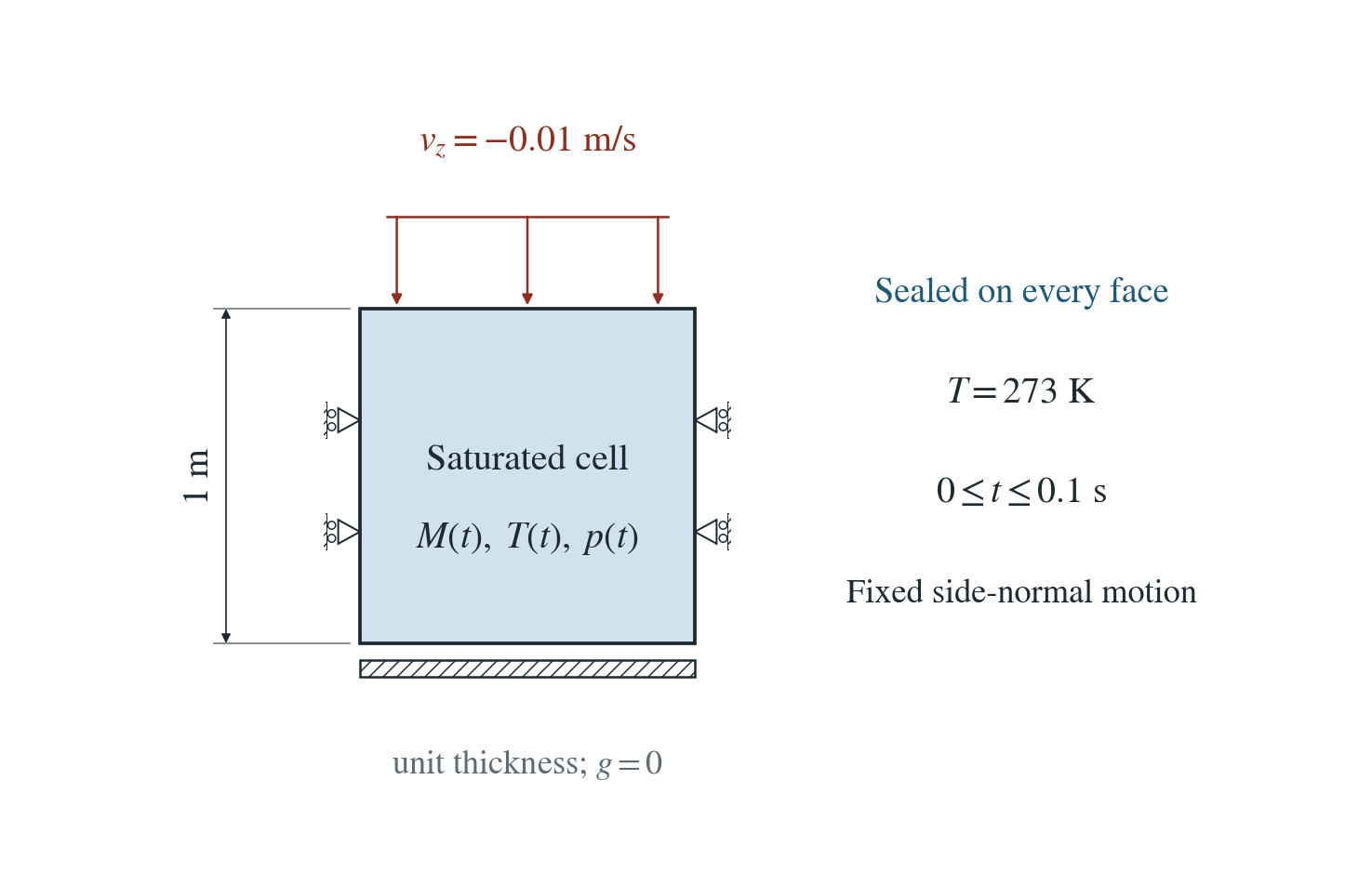
Motion. Unit cell with fixed side-normal motion and base. The top shortens at 0.01 m/s for 0.1 s; the mesh stays fixed and the inventory uses the implied bulk volume.
Water and temperature. Every face is sealed, initial pressure is zero, and temperature stays at 273 K. Gravity is zero.
Material. Saturated elasticity with evolving Eulerian Biot porosity and a constant-compressibility fluid EOS; no plasticity or recovery in this selected control.
Input and how to run
Every file this example needs is in data/mass/. Run from that folder:
# Compresses the sealed unit cell for 0.1 s in 4,000 steps and saves its pressure, physical water inventory and numerical buffer.
dynearthsol2d input.cfg
Settings that define this example
| Setting | Value | What it does here |
|---|---|---|
control.hydraulic_content_model | 1 | selects the finite-density saturated inventory law |
mat.porosity_model | 1 | evolves Eulerian Biot porosity from the accepted strain and pressure |
control.fixed_dt | 2.5e-05 | physical coupling interval; transport can subcycle within it |
mat.fluid_bulk_modulus | [1e8] | constant fluid compressibility in the exponential density law |
mat.bulk_modulus_s | [1e9] | grain compressibility in the porosity law |
mat.fluid_alpha | [.0002] | volumetric fluid thermal expansivity |
sim.output_step_interval | 400 | saved-frame interval; ledger entries belong to individual physical steps |
input.cfg holds all 68 settings that differ from DES’s defaults; dynearthsol2d -h lists every option with its default.
Output
See Running the examples for output files, the Python reader and ParaView conversion.
| Field | What to look at |
|---|---|
pore pressure | physical nodal pressure in Pa |
fluid mass | retained physical nodal water mass in kg |
hydraulic split buffer | numerical fixed-stress mass increment, excluded from density and heat |
solid heat capacity | material heat-capacity inventory, unchanged by fluid drainage |
temperature | temperature in K |
fluid mass balance | physical and numerical mass changes, measured boundary/source exchange and residual |
Result: DES and the analytical solution
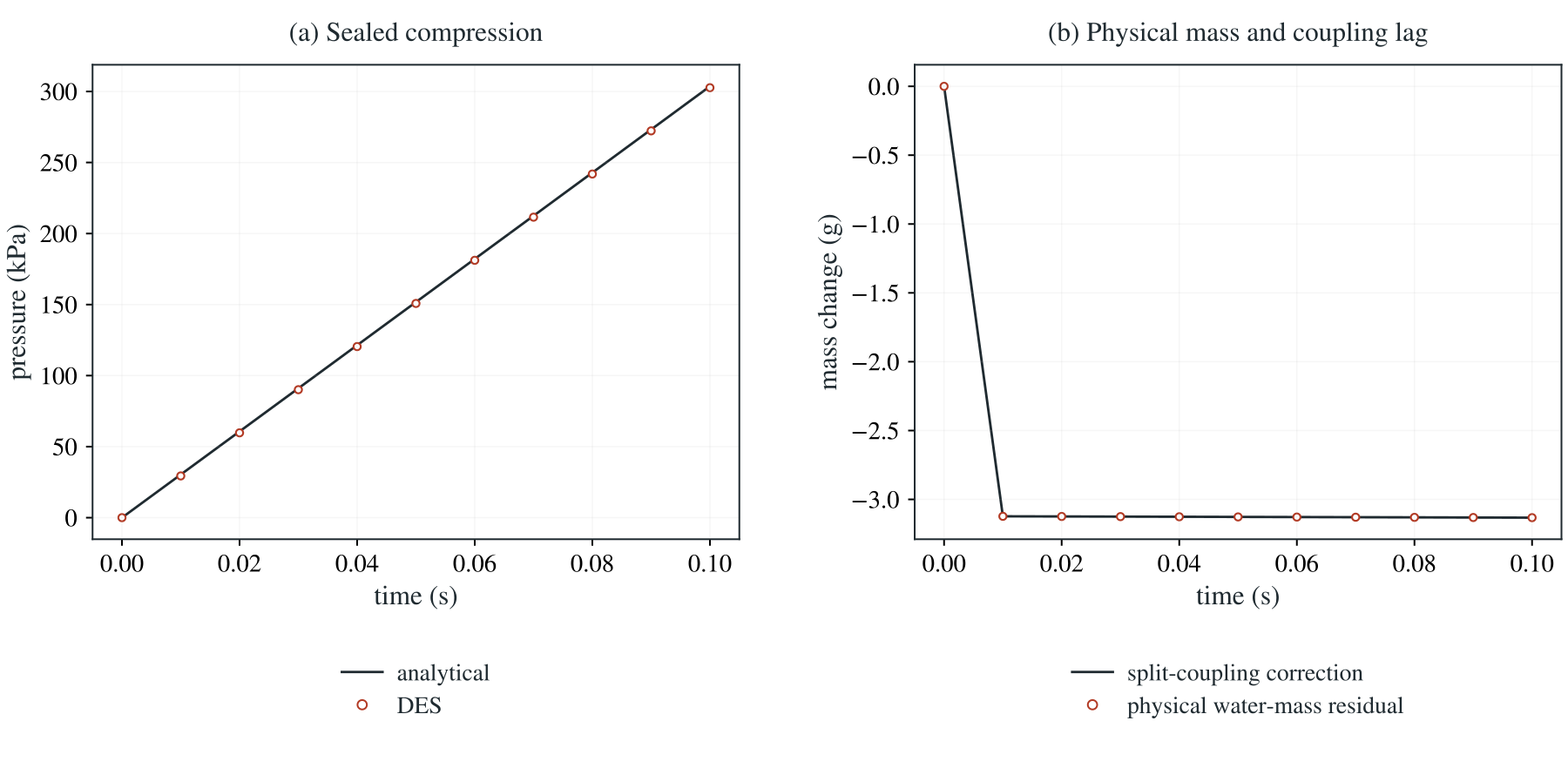
2D unit cell, 0.01/s logarithmic compression to 0.1 s, 4,000 physical steps. (a) DES and the implicit sealed-cell solution; (b) physical water-mass residual and the split-coupling correction. The temporal table retains 1,000 and 2,000 steps.
The stabilised split conserves M+R. R is a numerical lag, contributes no density or heat capacity, and must not be described as physical water. Native/HDF5, 3D, restart, remap, source and transport controls are supporting evidence.
History CSV · Temporal convergence
To reproduce the whole study behind this figure, from the DES source folder:
python3 tests/functional/hydromechanics/check_mass.py dynearthsol2d OUT --cases mass lag
The study’s full numbers: record.json.
Analytical reference
is the tension-positive bulk strain interpreted as log volume in the inventory law; is recovered pore dilation (zero here). , , MPa, GPa, MPa, MPa and kg per metre thickness. is an extensive numerical buffer, never physical mass.
Derivation
Integrating constant fluid compressibility and expansivity gives the density law. Integrating the Eulerian porosity rate gives the displayed porosity. The sealed continuum reference is the monotone scalar root M=M0, evaluated independently in mass_reference.py.
When fluid and grain moduli are equal, the implicit pressure has a closed form. The unequal-modulus reference shown here uses a bracketed root instead.
The fixed-stress pressure stabilizer leaves a separately recorded numerical mass increment. With sealed walls, physical M differs from M0 by minus R. Refining the physical timestep reduces this defect at first order; an exact M+R ledger alone does not establish exact physical mass conservation.
Direct EOS and porosity integration; independent scalar root and step-refinement controls in mass_reference.py and check_mass.py.
Validity and limits
Selected homogeneous isothermal prescribed-motion cell. The broader suite checks remapping and accepted-path spatial transport, but this figure does not establish finite-strain constitutive accuracy, unsaturated finite-density flow, buoyant hydrostatic balance or a full thermal energy equation.