Transient plumes: Elder's heater problem
A porous layer heated from below over part of its base grows plumes that rise, merge and spread under the cold top. Elder (1967) studied this problem in a Hele-Shaw cell; Voss and Souza (1987) later made its saline version a standard test of variable-density flow codes. It has no closed- form solution, and van Reeuwijk et al. (2009) showed that at its Rayleigh number of 400 several flow patterns are possible, so solutions depend on the grid. This page therefore compares DES with an independent solution of the same equations on several grids and shows both as they come out; nothing is tuned to make them agree.
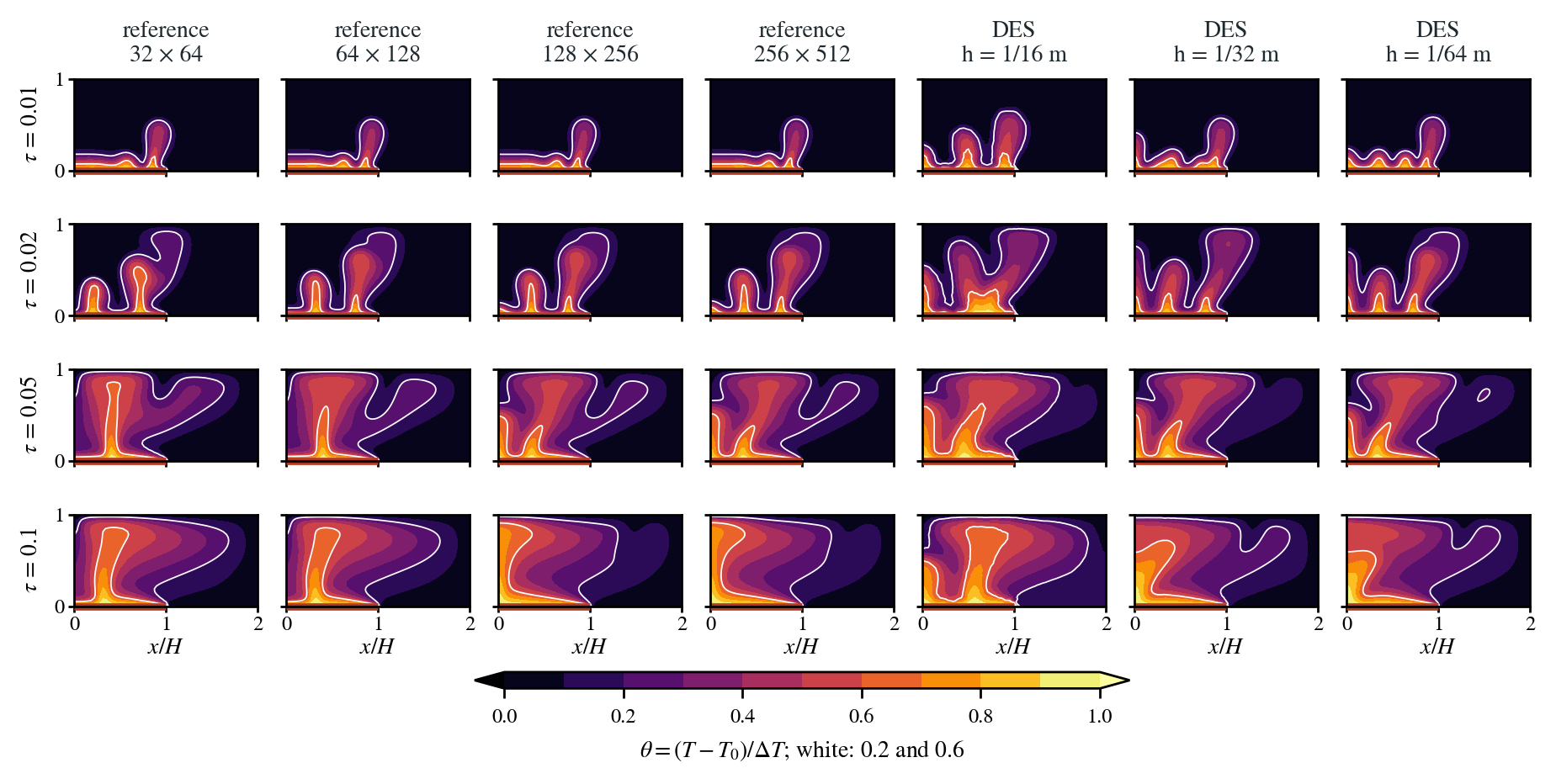
The two finest reference grids follow the same plume branch. Against it, the finest DES mesh reaches the same plume pattern at = 0.05 and 0.1, with the heat content of the layer differing by about 1 %. Early, while the first plumes form, DES grows more of them and its heat content is up to 14 % higher.
| Dimension | 2D |
| Build | make ndims=2 from the poromechanics source (not yet merged; DynEarthSol #134) |
| Inputs | elder.zip; reference benchmarks/poromechanics/elder_reference.py |
| Run time | 33 s, 6 min and 1 h 45 min on 8 threads for the three meshes |
| Reproduce with | DynEarthSol 3774df0 |
Run the selected case
Extract elder.zip and run from its folder with OMP_NUM_THREADS=8 dynearthsol2d input.cfg. It contains the selected 1/64 m input and elder.poly; the source commands below reproduce the full grid study.
Problem setup
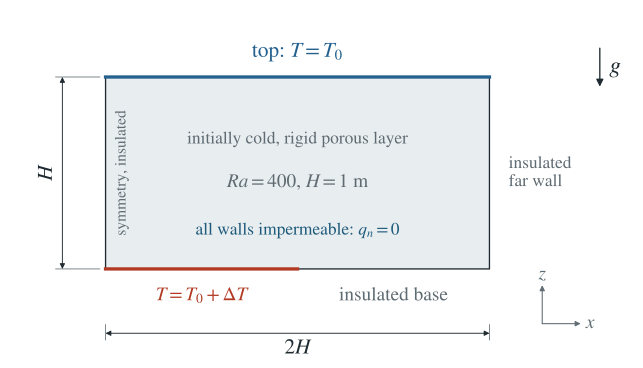
Box. The symmetric half of Elder's box: 2 m wide and 1 m high, with the
symmetry axis at . The base is held 10 K above the top over
m (the heater, bc.tbc_z0 on its own boundary flag in a
.poly mesh) and insulated beyond it (a slant boundary n0). The top is
held at ; the axis and the far wall are insulated; every boundary is
impermeable. The fluid starts at .
Equations. Boussinesq Darcy flow with heat conduction and advection, with the material constants of the onset benchmark, so that m²/s, and . The permeability gives
The matrix is rigid and does not feed back on the pressure; a fluid bulk modulus of 100 Pa makes pressure diffuse about 800 times faster than heat, close to the incompressible limit of the reference.
Runs. Three DES meshes ( = 1/16, 1/32 and 1/64 m; 1028, 3992 and 15692 nodes) with a fixed step of 50 s, to = 0.1. Voss and Souza's times of 1, 2, 4, 10, 15 and 20 years correspond to = 0.005, 0.01, 0.02, 0.05, 0.075 and 0.1.
Reference. elder_reference.py solves the same equations, written for
the stream function, with central differences on uniform grids of
32 × 64, 64 × 128, 128 × 256 and 256 × 512 cells and third-order
Runge–Kutta steps.
It checks its own heat budget without buoyancy and that plumes form with
it.
For dimensionless upward , temperature and stream function , the reference solves
Impermeable walls have . The heater has , the top , and the remaining thermal boundaries have zero normal temperature gradient. This is an independent numerical reference, not an analytical solution.
Results
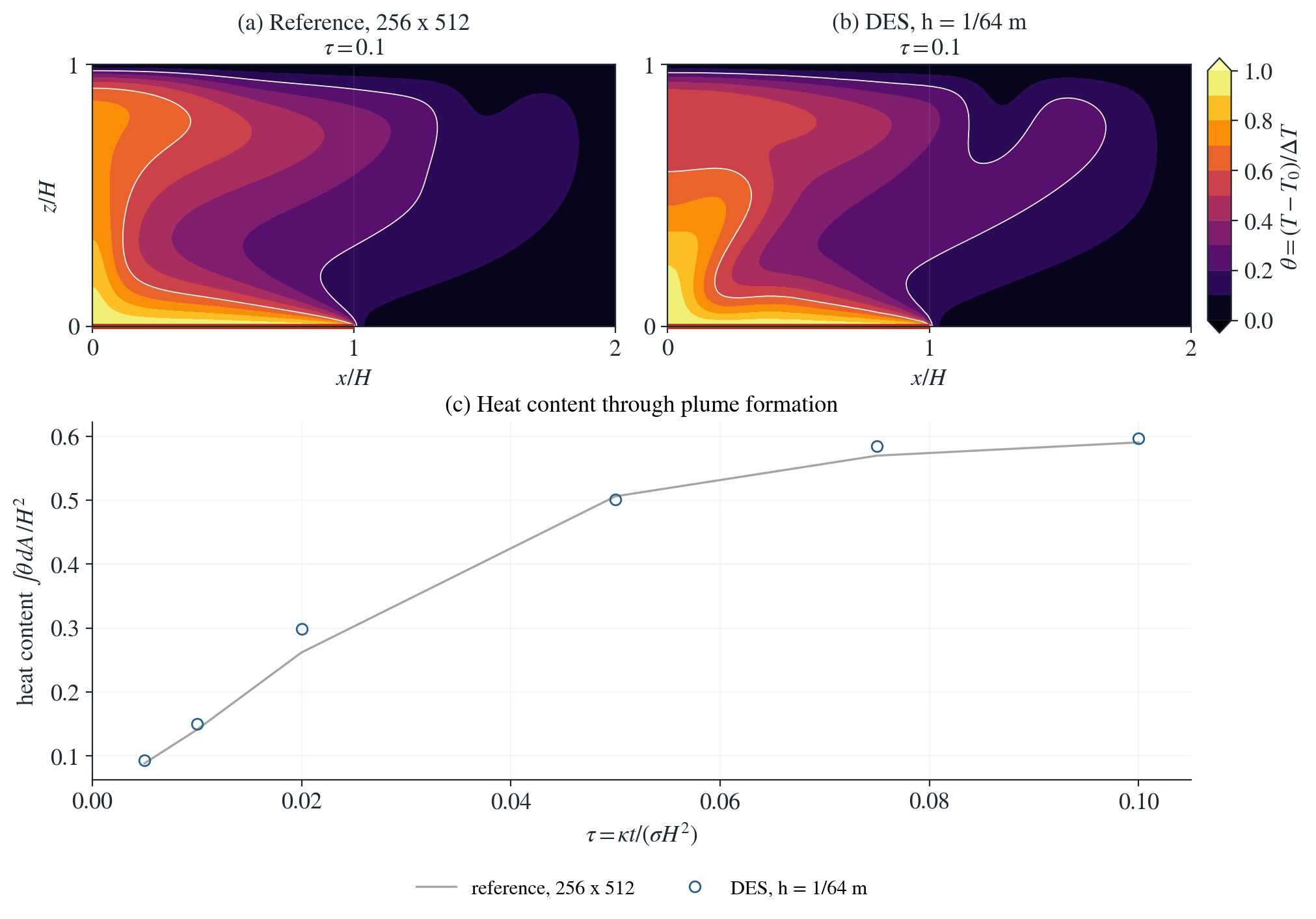
The selected comparison uses DES m and the 256 × 512 reference:
| Heat content, finest DES mesh | Reference | |
|---|---|---|
| 0.005 | 0.093 | 0.089 |
| 0.02 | 0.299 | 0.262 |
| 0.05 | 0.501 | 0.506 |
| 0.1 | 0.597 | 0.590 |
Supporting mesh and reference-grid comparisons
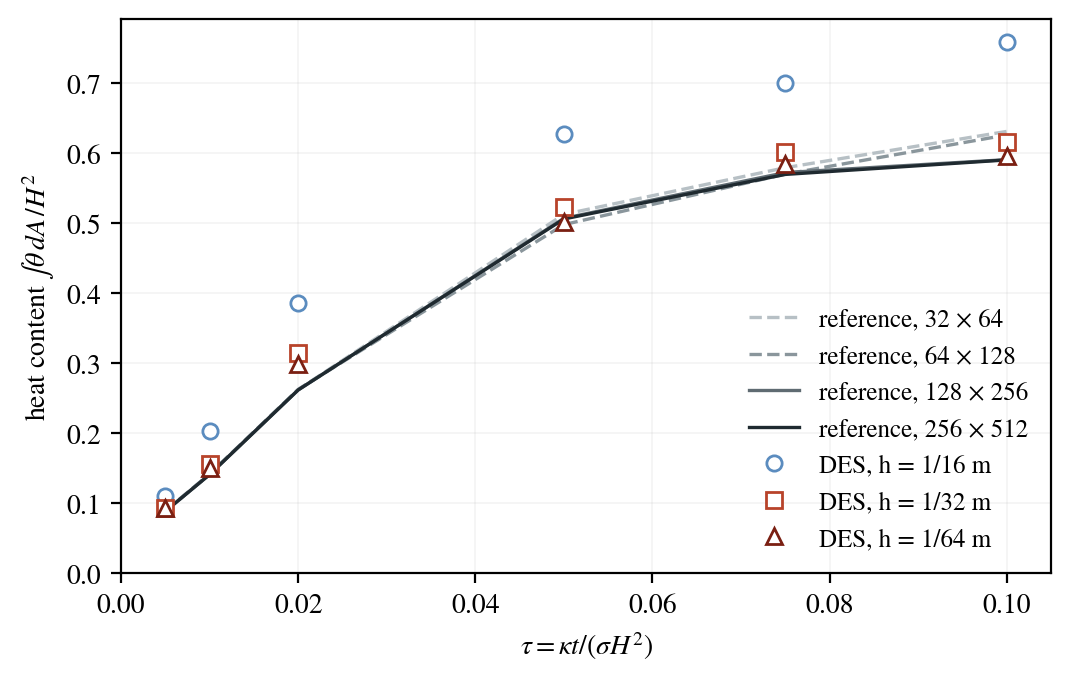
| Heat content, DES = 1/16 | 1/32 | 1/64 | Reference 256 × 512 | |
|---|---|---|---|---|
| 0.005 | 0.110 | 0.094 | 0.093 | 0.089 |
| 0.02 | 0.386 | 0.314 | 0.299 | 0.262 |
| 0.05 | 0.628 | 0.523 | 0.501 | 0.506 |
| 0.1 | 0.758 | 0.617 | 0.597 | 0.590 |
- Convergence. DES approaches the reference as the mesh is refined; the coarsest mesh carries too much heat at every time.
- Late times. At = 0.05 and 0.1 the finest DES mesh and the two finest reference grids show the same pattern: at = 0.05 a plume on the axis, a second plume over the heater and the outer plume bent out under the top, which by = 0.1 have become one broad plume on the axis spreading under the top. The two coarsest reference grids and the coarsest DES mesh show a plume away from the axis instead: the pattern itself depends on resolution, in both codes. The largest temperature difference from the finest grid is 0.14 at = 0.05 and 0.23 at = 0.1 (RMS 0.03 and 0.05).
- Early times. At = 0.01–0.02 DES grows more and narrower plumes along the heater, and its heat content is 4–14 % higher. Where the first plumes start depends on small disturbances; an unstructured triangle mesh and a regular grid seed them differently.
- The reference itself. Its 64 × 128 and 128 × 256 grids differ by up to 0.6 in temperature after = 0.05, where their plume patterns differ; its 128 × 256 and 256 × 512 grids differ by at most 0.12 at every time, and their heat contents agree within 0.5 %.
Limits
- Other branches. The two finest reference grids agree on one branch within , but at this Rayleigh number other flow patterns exist, and coarser grids of both codes fall onto them; later times were not compared.
- Half box. The symmetric half excludes asymmetric patterns of the full box.
- Slightly compressible fluid. The reference is incompressible; DES uses a fluid bulk modulus of 100 Pa so that the runs finish in hours.
References
Elder, J. W. (1967). Transient convection in a porous medium. Journal of Fluid Mechanics, 27(3), 609–623.
van Reeuwijk, M., Mathias, S. A., Simmons, C. T., & Ward, J. D. (2009). Insights from a pseudospectral approach to the Elder problem. Water Resources Research, 45, W04416.
Voss, C. I., & Souza, W. R. (1987). Variable density flow and solute transport simulation of regional aquifers containing a narrow freshwater-saltwater transition zone. Water Resources Research, 23(10), 1851–1866.