Steady hydrothermal convection: Nusselt number
Above onset the heated porous cell settles into a steady convection roll that carries several times the conductive heat flow. Its Nusselt number has no closed form; an independent fine-grid solution supplies it.
DES Nusselt numbers on the 0.0125 H mesh: Ra = 100: 2.6506 against 2.6459 (0.17%); Ra = 200: 3.8415 against 3.8098 (0.83%).
| Dimension | 2D |
| Build | make ndims=2 from the poromechanics source (not yet merged; DynEarthSol #134) |
| Inputs | nusselt.zip |
| Reproduce with | DynEarthSol 3774df0 |
Problem setup
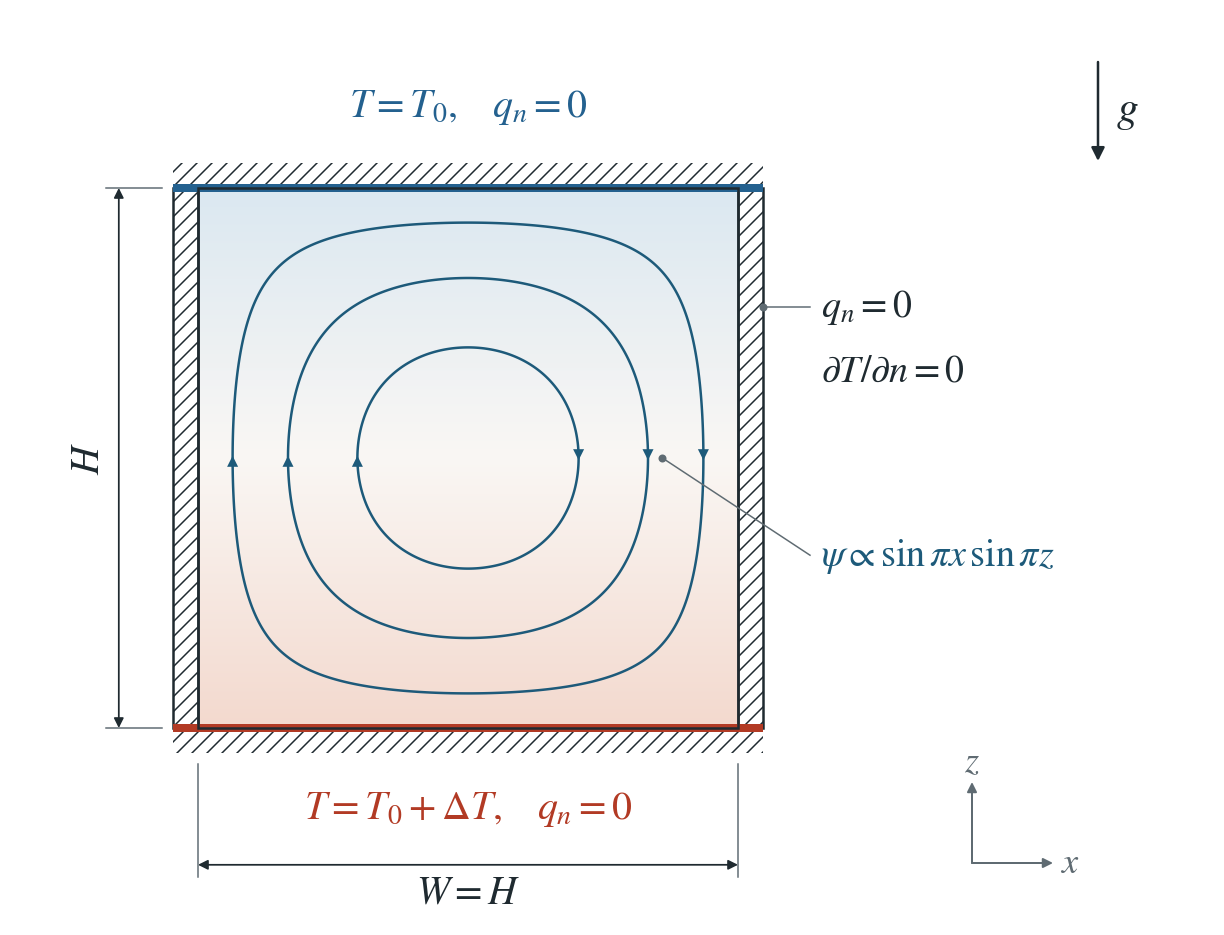
Cell. The Horton–Rogers–Lapwood square cell of the onset page, : impermeable walls, base at , top at , insulated sides, Boussinesq Darcy flow with heat conduction and advection.
Run. Each run starts from conduction with a seeded roll at or and continues until the heat transport stops changing. Storage does not enter the steady state, so a compressible pore fluid shortens the transient.
What is compared. The steady Nusselt number, from the volume form below and from the temperature gradient at the top, against an independent steady solution on three fine grids, extrapolated.
Input and how to run
Every file this example needs is in nusselt.zip. Run from that folder:
# Runs the 2D cell at Ra = 200 on the 0.0125 m mesh for 1600 steps of 1000 s, until the heat transport is steady, saving box.save.* every 50 steps with box.info listing the frames.
dynearthsol2d input.cfg
Settings that define this example
| Setting | Value | What it does here |
|---|---|---|
control.has_fluid_thermal_advection | true | turns on heat transport by the Darcy flux |
mat.fluid_alpha | [0.001] | water thermal expansion α_f = 1e-3 /K; with the default gravity it drives buoyancy |
mat.hydraulic_perm | [2e-09] | permeability chosen to give Ra = 200 (the study also runs Ra = 100) |
bc.tbc_z0 | 1 | 1: fixed temperature at the base |
bc.tbc_val_z0 | 283.0 | base temperature T_0 + ΔT = 283 K |
bc.tbc_val_z1 | 273.0 | top temperature T_0 = 273 K; the sides are insulated |
ic.temperature_option | 5 | 5: linear conduction profile plus a Gaussian seed |
ic.temp_anomaly_amplitude | 0.5 | 0.5 K seed, large enough to start a single roll quickly |
mat.fluid_bulk_modulus | [10.0] | a very compressible pore fluid; storage only sets the transient, so this shortens the run without changing the steady state |
control.has_poroelastic_pressure_feedback | false | off: a rigid matrix |
mesh.resolution | 0.0125 | 0.0125 m, the finest mesh of the study |
sim.max_steps | 1600 | 1600 steps of 1000 s, long enough for Nu to stop changing |
sim.output_step_interval | 50 | 50 steps: the Nu history in panel (b) |
input.cfg holds all 60 settings that differ from DES’s defaults; dynearthsol2d -h lists every option with its default.
Output
See Running the examples for output files, the Python reader and ParaView conversion.
| Field | What to look at |
|---|---|
temperature | nodal temperature; isotherms in panel (a) and the heat transport in the Nusselt number |
pore pressure | with the temperature, rebuilds the Darcy flux used in the volume form of Nu |
Result: DES and the reference
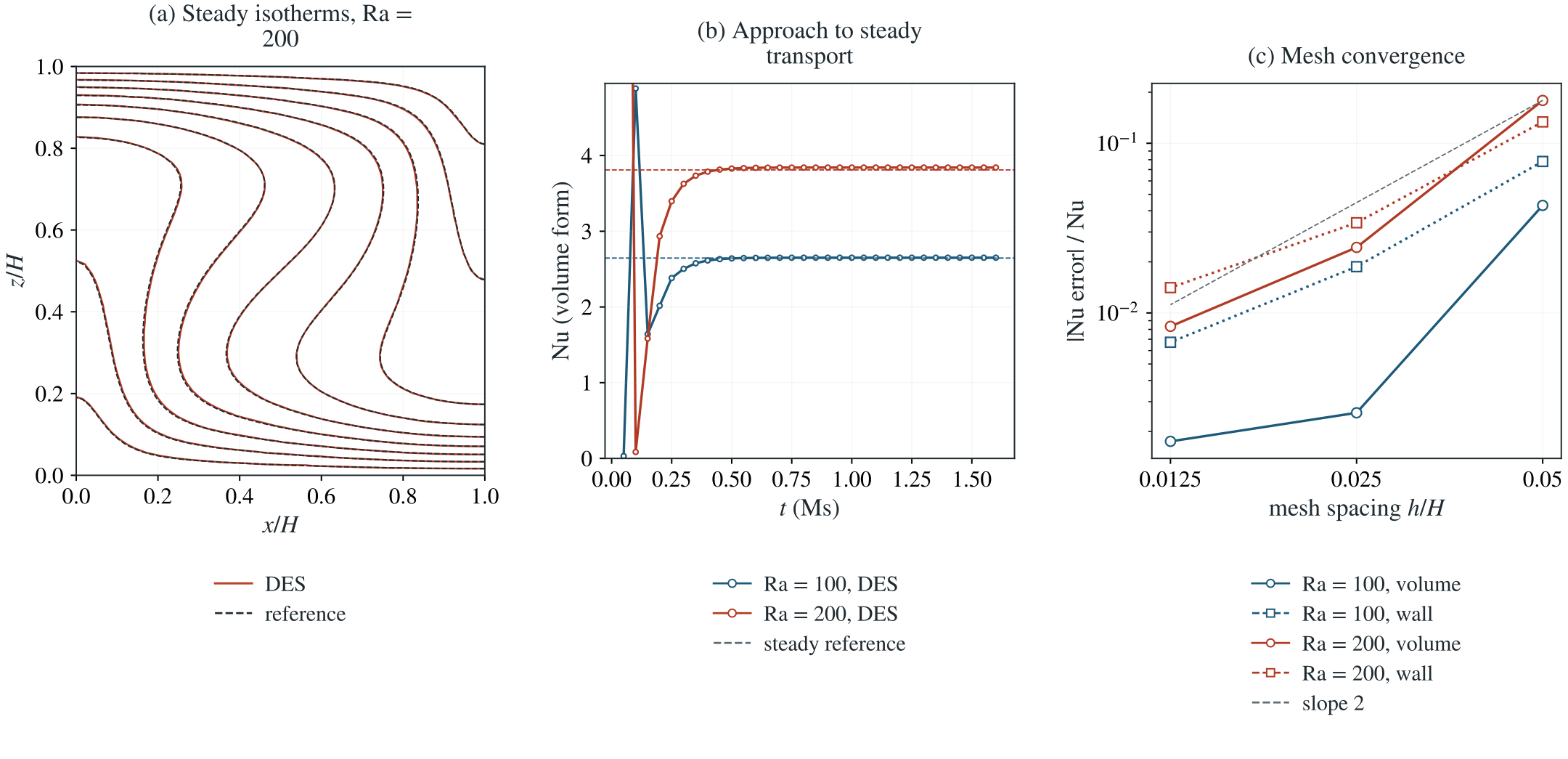
(a) Isotherms of the steady roll at Ra = 200: solid, DES; dashed, the independent fine-grid solution. (b) Nusselt number (volume form) against time as the cell approaches steady transport. (c) Nusselt-number error against mesh spacing for both Rayleigh numbers.
This checks finite-amplitude Darcy convection: buoyancy, heat advection by the Darcy flux and conduction together, through the heat they carry. Storage only sets the transient, so a compressible pore fluid shortens the runs; the transient itself is not compared.
To reproduce the whole study behind this figure, from the DES source folder:
python3 benchmarks/poromechanics/convection_steady.py
python3 tests/functional/hydromechanics/check_convection_nusselt.py dynearthsol2d OUT --spacings 0.05 0.025 0.0125
The study’s full numbers: record.json.
Reference solution (numerical)
, lengths are scaled by and is the dimensionless streamfunction; is the vertical Darcy flux and the volume mean. The second form of Nu follows from the steady heat balance at every height, averaged over the cell; it is the one evaluated on DES fields, with rebuilt from the saved pressure and temperature.
Derivation
Taking the curl of Darcy’s law with Boussinesq buoyancy removes the pressure and gives the streamfunction equation; the energy balance is steady advection–diffusion.
convection_steady.py solves both with second-order central differences on , and grids by relaxed Picard iteration and extrapolates Nu (observed order 1.99). Below onset it returns the conductive ; at Ra = 100 it gives 2.6459, matching published values near 2.65.
Horton and Rogers (1945); Lapwood (1948); steady values as in Caltagirone (1975). Computed independently in convection_steady.py.
Validity and limits
Steady state only: the transient depends on storage, which is chosen for speed. Single-roll solution, as seeded; Boussinesq, constant properties, no mechanical coupling.