Thermal pressurization in a sealed cell
Uniform supplied heat warms a rigid, sealed porous material. The temperature rise and fluid expansion give independent heat and pressure references.
The 10 K pulse raises the pore pressure to 154.799 kPa. Pressure and stored heat match their references to round-off.
| Dimension | 2D |
| Build | make ndims=2 from the poromechanics source (not yet merged; DynEarthSol #134) |
| Inputs | thermal-cell.zip |
| Reproduce with | DynEarthSol 3774df0 |
Problem setup
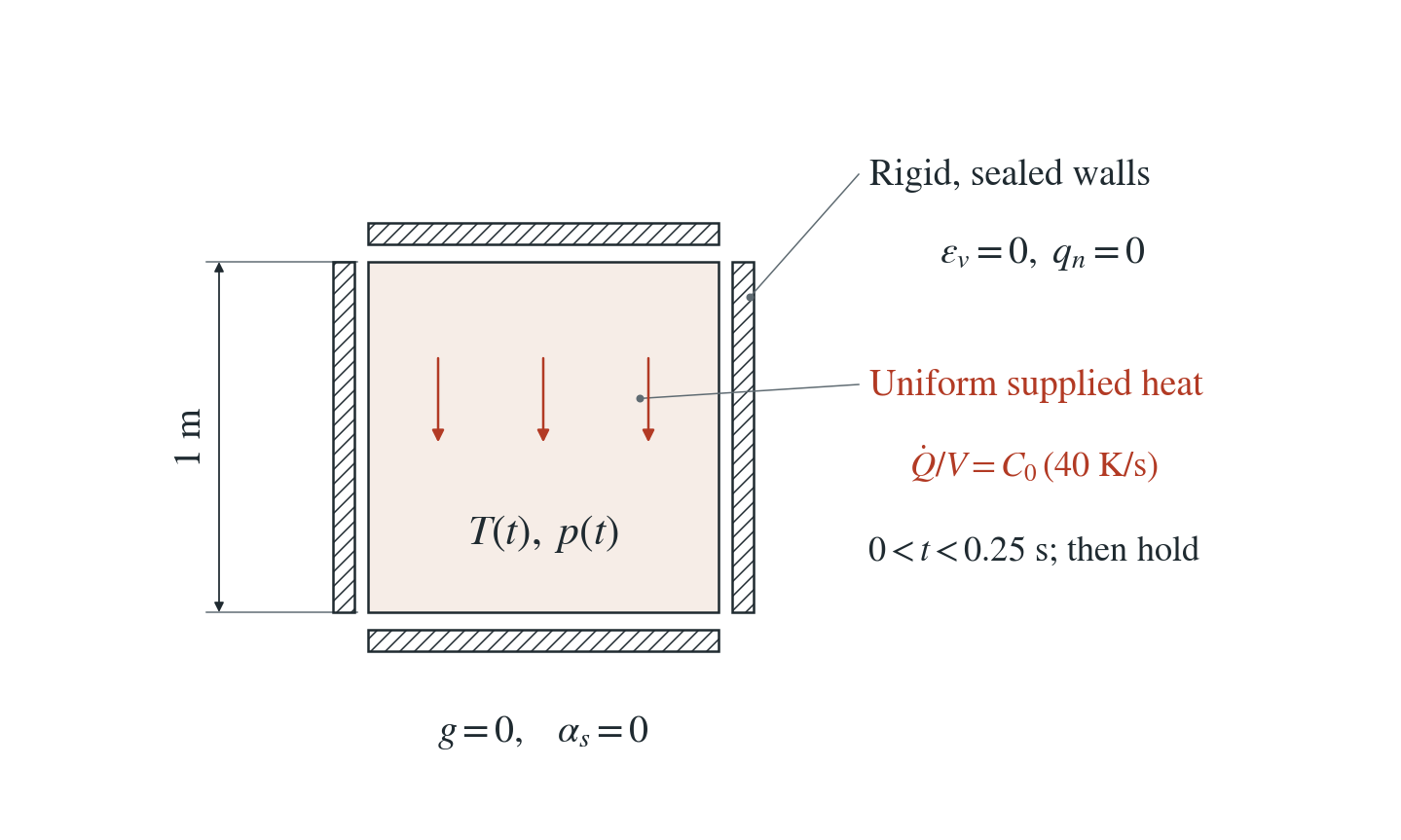
Geometry. Rigid unit material cell, zero gravity, fixed mesh and constant porosity. Every water boundary is sealed in the selected result.
Heating. Temperature starts at 273 K. A uniform supplied power raises it at 40 K/s for 0.25 s, followed by a hold through 1 s.
Coefficients. No conduction, Darcy permeability or solid thermal expansion. The heat is supplied by one point source per node, each proportional to the volume that node represents.
Input and how to run
Every file this example needs is in thermal-cell.zip. Run from that folder:
# Heats the 2D cell for 100 steps of 0.01 s (1 s) with ordinary explicit mechanics and writes heated.save.* and heated.chkpt.* at every step, with heated.info listing the frames.
dynearthsol2d input.cfg
Settings that define this example
| Setting | Value | What it does here |
|---|---|---|
control.has_thermal_pressurization | true | couples thermal expansion of water and solid to the fluid content and stress |
control.has_fluid_thermal_advection | true | uses the combined rock–water heat capacity C_0 (there is no flow to advect heat here) |
heat_injection.enabled | true | turns on scheduled point heat sources |
heat_injection.num_points | 9 | nine sources, one at each node of the 3×3-node mesh |
heat_injection.points_x | [0.0, 0.0, 0.0, 0.5, 0.5, 0.5, 1.0, 1.0, 1.0] | x coordinates of the nine nodes |
heat_injection.points_z | [-1.0, -0.5, -0.0, -1.0, -0.5, -0.0, -1.0, -0.5, -0.0] | z coordinates of the nine nodes |
heat_injection.rate | [10108333.333333332, 10108333.333333332, 10108333.333333332, 10108333.333333332, 40433333.33333333, 10108333.333333332, 10108333.333333332, 10108333.333333332, 10108333.333333332] | heat supplied at each node (W per metre of thickness in 2D), proportional to the volume the node represents, so the cell warms uniformly at 40 K/s |
heat_injection.duration_in_yr | [7.922191133769641e-09, 7.922191133769641e-09, 7.922191133769641e-09, 7.922191133769641e-09, 7.922191133769641e-09, 7.922191133769641e-09, 7.922191133769641e-09, 7.922191133769641e-09, 7.922191133769641e-09] yr = [0.25, 0.25, 0.25, 0.25, 0.25, 0.25, 0.25, 0.25, 0.25] s | 0.25 s of heating (in years), followed by a hold to 1 s |
bc.vbc_x0 | 3 | type 3: every velocity component fixed; with the other faces also 3 the cell is rigid |
mat.therm_cond | [0] | 0: no conduction, so the temperature stays uniform |
mat.fluid_alpha | [0.0002] | water thermal expansion α_f = 2e-4 /K, the source of the pressure |
mat.alpha | [0] | 0: no solid thermal expansion |
mat.biot_coeff | [0.98] | α = 0.98 = 1 − K/K_s |
mat.fluid_bulk_modulus | [100000000.0] | K_f = 100 MPa; with porosity and K_s it sets the storage S |
input.cfg holds all 67 settings that differ from DES’s defaults; dynearthsol2d -h lists every option with its default.
Output
See Running the examples for output files, the Python reader and ParaView conversion.
| Field | What to look at |
|---|---|
temperature | nodal temperature; its volume-weighted mean is the temperature rise in panel (a) and gives the stored heat in panel (b) |
pore pressure | nodal pressure; its volume average is the sealed pressure in panel (a) |
Result: DES and the analytical solution
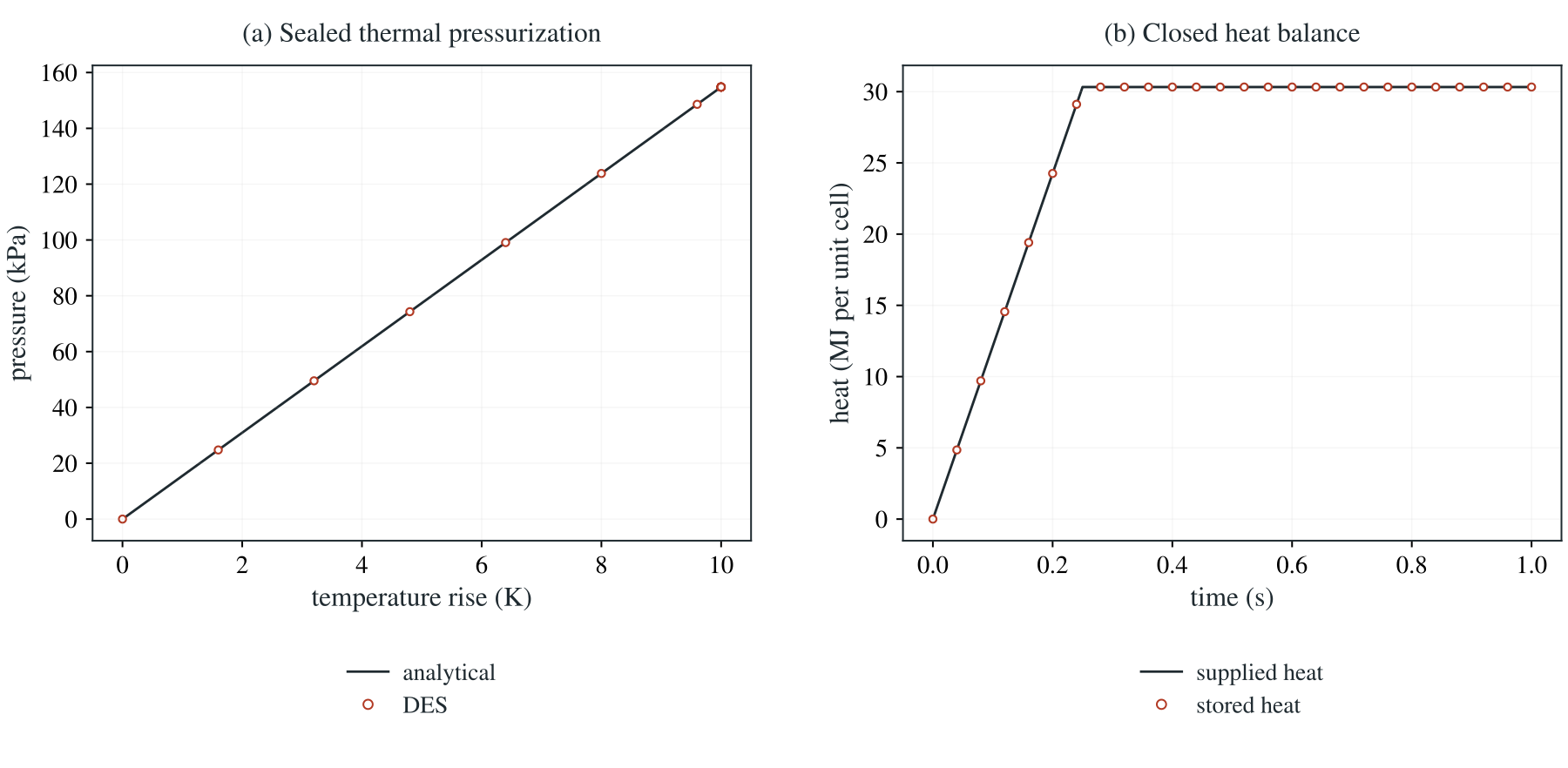
(a) Pore pressure of the sealed, rigid cell against its temperature rise: line, the sealed linear reference βθ/S; symbols, DES. (b) Heat stored in the cell (symbols, DES) and heat supplied by the sources (line) against time.
This checks thermal pressurization of pore water and the heat equation with a supplied heat source. The same comparison holds in 2D and 3D, for several time steps and across restarts. With PT the pressure lags the heating by a first-order amount. A drained version of the cell misses 10,450 J (0.03446% of the supplied heat) because the heat capacity stays fixed while water leaves, so the energy balance of open systems such as thermal plumes is not covered.
History CSV · Control tables
To reproduce the whole study behind this figure, from the DES source folder:
python3 benchmarks/poromechanics/thermal_cell.py dynearthsol2d OUT/2d --dt .01
python3 benchmarks/poromechanics/thermal_cell.py dynearthsol2d OUT/2d-fine --methods pt --boundaries fixed --dt .000625
python3 benchmarks/poromechanics/thermal_cell.py dynearthsol3d OUT/3d --ndims 3 --dt .01
The study’s full numbers: record.json.
Analytical reference
MPa, MPa, GPa, MPa, , and K. MJ/(m³ K). is the PT stabilizer, with in 2D and in 3D. is the separate drained control’s retained-fluid enthalpy residual.
Derivation
For a sealed rigid cell, total volumetric strain and fluid-content change vanish. This gives the physical pressure directly.
The fixed-capacity heat equation integrates the supplied pulse exactly. The selected explicit pressure follows the physical content equation. PT instead retains its pending increment; the displayed recurrence is exact for that split, and its physical-pressure error is first order for small timesteps.
For the additional drained rigid cell, all vertices hold zero pressure. Fluid expansion must leave through the boundary reaction.
The retained fluid mass changes the heat capacity. Outflow carries enthalpy at the changing cell temperature.
Use retained mass in the energy change, rather than integrating the original fixed capacity.
Adding outflow enthalpy and subtracting the supplied heat produces the displayed negative half-quadratic deficit. At 10 K it is −10,450 J, or 0.03446% of supplied heat, independent of timestep. There is no strain work or pressure-boundary work in this rigid, zero-pressure control.
Linear Biot thermal expansion and integration of the stated heat pulse; the retained-fluid deficit is derived for the implemented linear fluid-content law.
Validity and limits
This sealed cell checks thermal pressurization and the fixed-capacity heat equation. With PT the pressure can lag noticeably during rapid heating even when the force balance converges. In a drained cell a small, persistent energy deficit remains, so open systems such as thermal plumes are not covered; shear heating is not included.